QLD Licence Disqualification for DUI: A Complete Guide
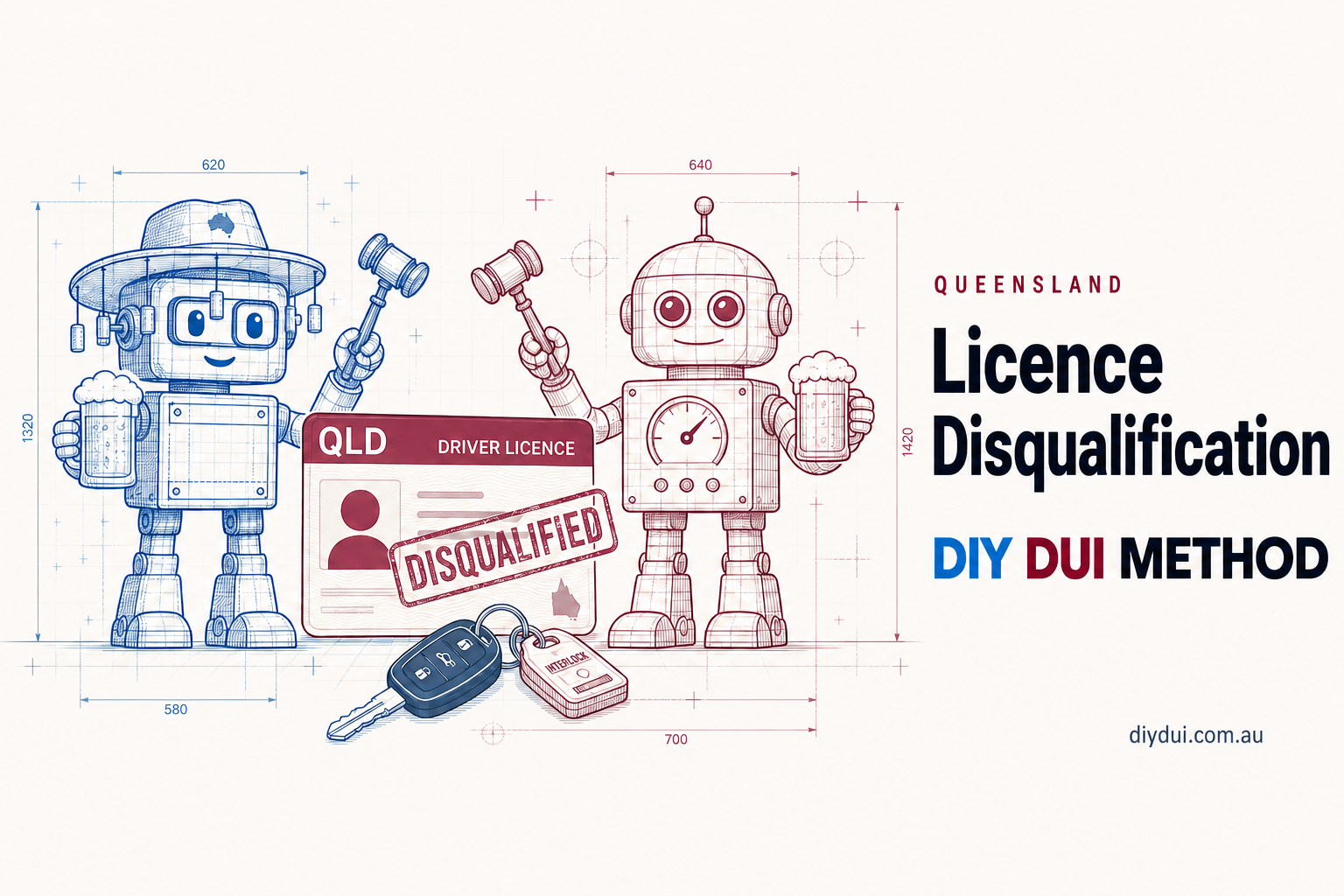
Queensland drink and drug driving charges carry licence disqualification under the Transport Operations (Road Use Management) Act 1995 (Qld). The court cannot go below the statutory floor. Interlock does not shorten that floor. A restricted work licence under s 87 is the main way some eligible drivers keep driving for work during the disqualification.
Key point. The court cannot go below the statutory floor. Interlock does not shorten that floor. A restricted work licence under s 87 is the main way some eligible drivers keep driving for work during the disqualification.
This is general information, not legal advice. It is current as at 27 August 2026, using the TORUM Act as in force on 1 July 2026. See also the QLD drink and drug driving laws hub and the QLD drink driving penalties table.
What disqualification actually is
If you are disqualified, you must not drive. The court disqualification starts from conviction (s 86). That is separate from any police or roadside action before court.
Immediate suspension under s 79B is not automatic for every charge. It does apply if you are charged with:
- driving under the influence;
- driving over the middle alcohol limit (s 79(1F));
- failing to provide a specimen;
- certain lower-range charges while another is still pending; or
- aggravated dangerous operation while adversely affected.
A first open-licence charge over 0.05 but under 0.10 is not, by itself, an s 79B immediate suspension. Queensland Transport also describes a 24-hour suspension for some lower readings. Time already served on an s 79B suspension can be taken into account when the court sets the disqualification (s 86(7)).
A first-time over-general charge is still a court matter. See 1st time drink driving charge in Queensland and what to expect in a QLD drink driving court.
Queensland’s alcohol limits, not NSW labels
The Act does not use NSW “low / mid / high range PCA” as the charging language. It uses:
- general alcohol limit: 0.050 (s 79A(2))
- middle alcohol limit: 0.100 (s 79A(2A))
- high alcohol limit: 0.150 (s 79A(3))
Over the high limit is presumed to be under the influence (s 79(3)). Under-the-influence can also be charged on observations, not only on a 0.150 reading.
Minimum disqualification periods (s 86)
These are the usual first-offence floors where there is no relevant conviction in the previous 5 years. The court may impose longer. It cannot impose shorter.
Open licence, first offence
| Offence (open licence, first) | s 86 floor | Section |
|---|---|---|
| Over general but not middle (0.050 to under 0.100) | 1 to 9 months, decided by the court | s 86(2)(f), (2A) |
| Over middle but not high (0.100 to under 0.150) | 3 to 12 months | s 86(2)(ea), (2A) |
| Under the influence, including over 0.150 | 6 months automatic. The court may order a longer period or absolute disqualification. It cannot go below 6 months | s 86(1), (5) |
Learner, probationary, provisional, restricted or unlicensed drivers often face a higher first-offence floor of 3 to 9 months for the lower-limit offences (s 86(2)(e)). Zero-alcohol drivers (including learners and P-platers over 0.00 but under 0.05) are a separate s 79 offence with that higher floor.
If you have a relevant drink, drug-driving or related conviction in the previous 5 years, the floors jump. Examples:
| Repeat example (relevant conviction in previous 5 years) | s 86 floor | Section |
|---|---|---|
| Under the influence with one prior s 79(1) in 5 years | 1 year automatic | s 86(1A) |
| Under the influence with more than one prior s 79(1) in 5 years | 2 years automatic | s 86(1B) |
| A second offence in the lower/middle class in 5 years | 3 to 18 months | s 86(2B) |
| More than one prior in that lower/middle class | 6 months automatic | s 86(2D) |
Key point. Repeat floors are not 12, 24 and 36 months. They follow s 86, including 1 year and 2 years automatic for under-the-influence with prior s 79(1) convictions in 5 years.
The court looks at BAC or the presence of a relevant drug, and the danger to the public, when it is choosing inside a range (s 86(2A)). Aggravating and mitigating facts can move the period up inside or above the floor. They cannot move it below the floor. You cannot apply to “reduce” a mandatory s 86 period for hardship, family responsibilities, employment, or no conviction recorded.
Restricted work licence (s 87)
If you are eligible, the same court that disqualifies you can order a restricted licence so you can drive only in stated circumstances connected with earning your livelihood. You must apply in the approved form at that hearing, before the disqualification order is made (s 87(2)). You must show you are a fit and proper person having regard to road safety, and that refusal would cause extreme hardship to you or your family by taking away your means of earning a livelihood (s 87(5)(a)).
You cannot get one if, among other bars:
- you have a relevant drink, drug or dangerous-driving conviction or disqualification in the previous 5 years;
- the offence was while working, while unlicensed for that class of vehicle, or while already on a restricted licence; or
- the conviction is under s 79(1) (under the influence) or a zero-alcohol offence (s 87(5)(da)).
A first open-licence over-general or middle-range charge is where s 87 is most often in play. Middle-range (s 79(1F)) restricted licences are still subject to the interlock condition (s 91K(2)). Official TMR information is on the restricted (work) licence page. The QLD + Work Licence program is built for eligible drivers who are pleading guilty and self-representing.
Alcohol ignition interlock
Key point. Interlock is not a 25% discount on the disqualification. Completing it does not turn 6 months into 4.5 months.
For a “drink driving offence” as defined in s 91I (including under the influence of liquor, middle-range, fail to provide, some repeats of lower-range offences, and some alcohol-aggravated dangerous operation), a licence issued after the disqualification ends is subject to an interlock condition (s 91K). You may then drive only a nominated vehicle fitted with a prescribed interlock, unless an exemption applies.
The prescribed period is 12 months of holding a valid licence with a fitted interlock or a valid exemption (s 91N). That 12 months need not be continuous. If you do not complete it, the interlock period can continue for up to 5 years from the end of the disqualification (s 91M). Queensland’s program is performance-based: alcohol detections or missed services can extend the time.
If you do not participate at all, you cannot return to ordinary driving during that interlock period. That is in addition to the court disqualification, not instead of it. See the Queensland Government pages on alcohol ignition interlocks and the performance-based interlock program.
Getting a licence back
When the disqualification ends you apply to TMR to be licensed again. You will usually be issued a probationary licence. You may also need the brief intervention or repeat drink-driver education program (Part 3A) and, if s 91K applies, an interlock-conditioned licence. TMR sets this out under being charged with drink driving and drink driving education programs.
What actually helps at sentence
The following can affect the fine, whether a conviction is recorded, and where the court lands inside or above a s 86 range:
- character references;
- an apology letter;
- a traffic offender or drink-driving education program;
- employment evidence; and
- family material.
They are not a basis for going below the statutory disqualification floor.
External resources
- Transport Operations (Road Use Management) Act 1995 (Qld), especially ss 79, 79A, 79B, 86, 87, 91I–91N
- Penalties and Sentences Act 1992 (Qld)
- Queensland Government, Drink driving penalties (TMR)
- Queensland Government, Restricted (work) licence
Prepare your QLD guilty plea
Queensland licence disqualification, explained for a plea.
The DIY DUI Method is information and self-preparation only. It is not legal representation and not personal legal advice. If your matter is contested, high-range, crash-related, or you are unsure how to plead, get advice from a qualified Queensland lawyer.
If you are pleading guilty and self-representing in Queensland, the QLD Plea Program and the QLD + Work Licence program are built for that exact situation.
QLD Plea Program
QLD + Work Licence
Information only, not legal advice. Browse the QLD laws & offences hub.