QLD DUI Sentencing: Court Process & Outcomes Guide
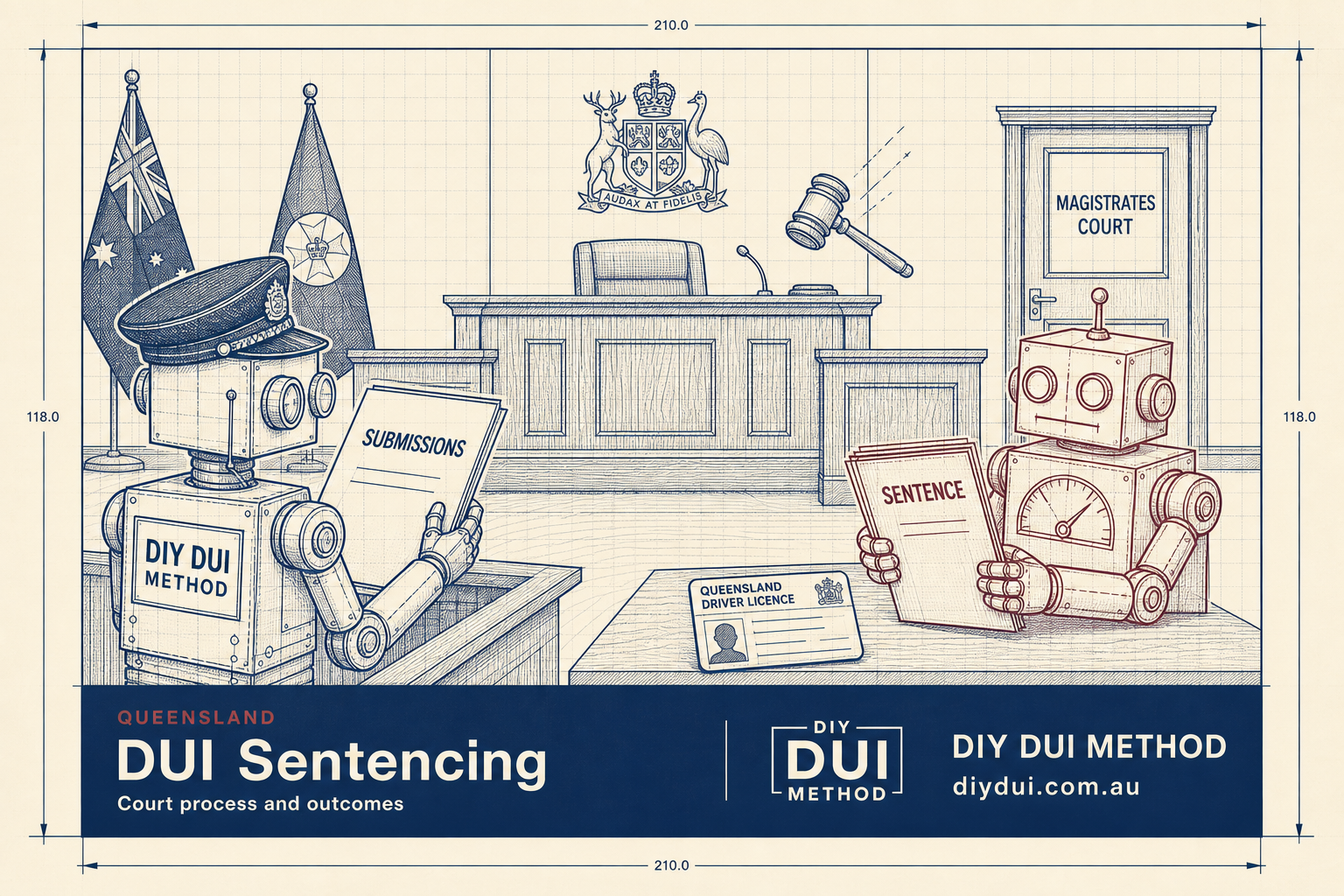
Queensland does not charge “DUI” as a single offence. Drink and drug driving is sentenced in the Magistrates Court under the Transport Operations (Road Use Management) Act 1995 (Qld) and the Penalties and Sentences Act 1992 (Qld). This guide is how that hearing actually runs, what the magistrate can and cannot do, and where family, character and a guilty plea fit.
Key point. Character, family hardship and a guilty plea can move the fine, whether a conviction is recorded, and community-based orders. They cannot cut the licence disqualification below the floor in TORUM s 86. That floor applies whether or not any other sentence is imposed (s 86(6) and (8)).
This is general information about Queensland law, current as at 29 August 2026, using the TORUM Act as in force on 1 July 2026. It is not legal advice and it is not a prediction of your sentence. See also the QLD licence disqualification guide and what to expect at drink driving court.
The usual Queensland path
Most drink and drug driving charges are dealt with in the Magistrates Court, not by a judge. After a guilty plea or a finding of guilt, the magistrate either sentences you that day or lists a later sentencing date. Queensland Government sentencing guidance puts it in those two options.
A typical same-day plea looks like this:
- the charge is read and you plead guilty;
- the prosecutor hands up the facts, your traffic and criminal history, and any BAC or drug certificate;
- you or your lawyer make submissions (early plea, remorse, work, family, rehabilitation);
- you may address the court briefly if you want to. You do not have to;
- the magistrate sentences: fine, whether to record a conviction, disqualification, and any other order.
If you want a restricted work licence, the s 87 application has to be made at that same conviction hearing, before the disqualification order, and not later. See s 87: am I eligible?.
What the magistrate must consider
PSA s 9 sets the purposes of sentence (punishment, rehabilitation, deterrence, denunciation, community protection) and the matters the court must have regard to. Those include the maximum and any minimum penalty, how serious the offence was, your character, age and antecedents, hardship on you, and, regardless of exceptional circumstances, the probable effect of the sentence on a person you primarily care for (s 9(2)(fa) and (fb)).
A guilty plea must be taken into account and may reduce the sentence that would otherwise have been imposed (PSA s 13). Voluntary intoxication by alcohol or drugs is not a mitigating factor (s 9(9A)).
Often treated as making the matter more serious
- a high reading, including over the high alcohol limit (0.150), which is presumed under the influence;
- failing to provide a specimen, which is taken to be a s 79(1) offence (s 80(11));
- crash, injury, or dangerous driving with the drink or drug charge;
- passengers, especially children;
- a relevant conviction in the previous 5 years;
- offending while already unlicensed, suspended, or on a restricted, learner or provisional licence.
Often treated as reducing the penalty inside the available range
- an early guilty plea;
- genuine remorse and insight;
- limited or no relevant history;
- stable work and family responsibilities;
- documented health issues;
- counselling, education, or a bail program actually completed (s 9(2)(o));
- character references that speak to the person the court is sentencing, not a template letter. See DUI character references in Queensland.
Family does count. It does not rewrite s 86. The court must consider the effect of sentence on people you care for. That can support a lower fine, no conviction recorded, or a community-based order. It is not a way around the statutory disqualification floor, and a s 87 work licence is a livelihood test, not a general family-transport discount.
Fines are penalty units, not a $200–$2,000 band
TORUM s 79 sets maximum fines in penalty units, with imprisonment as an alternative. One penalty unit is $172.70 from 1 July 2026 (Queensland Government sentencing guidance, current as at 4 August 2026). The court decides the actual fine up to the maximum. These are first-offence maxima. Repeat windows in s 79 are higher.
| Usual first offence (open licence) | Maximum fine | Maximum imprisonment | Section |
|---|---|---|---|
| Over general but not middle (0.050 to under 0.100), and first drug-present on an open licence | 14 penalty units ($2,417.80) | 3 months | s 79(2), s 79(2AA) |
| Over middle but not high (0.100 to under 0.150) | 20 penalty units ($3,454.00) | 6 months | s 79(1F) |
| Under the influence, including over 0.150 or fail to provide | 28 penalty units ($4,835.60) | 9 months | s 79(1); s 80(11) |
There is also an offender levy on sentence under PSA part 10A. It is separate from the fine, and the court must not have regard to it when fixing the sentence (s 9(9)).
Licence disqualification sits beside the sentence
Disqualification is not an optional extra the magistrate can skip because the fine is enough. On conviction, s 86 disqualifies you for at least the statutory period. The court may order longer or absolute disqualification (s 86(5)). It cannot go below the floor. Immediate police suspension under s 79B, where it applies, is a pre-court step. The court may take time already served on that suspension into account (s 86(7)).
| Usual first-offence floor (no relevant conviction in 5 years) | s 86 floor |
|---|---|
| Over general but not middle, and other “any other case” s 86(2) matters such as first drug-present on an open licence | 1 to 9 months, decided by the court |
| Over middle but not high | 3 to 12 months |
| Under the influence, including over 0.150 or fail to provide | 6 months automatic. The court may go longer. It cannot go below 6 months |
Learner, probationary, provisional, restricted or unlicensed drivers often face a higher first-offence floor of 3 to 9 months for the lower-limit offences. A relevant prior in 5 years jumps the floors. Detail is in the disqualification guide and the 5-year rule article.
An alcohol ignition interlock period, and the brief intervention education program, are licensing consequences after certain alcohol-related convictions (TORUM Part 3B). Completing interlock is not a pre-sentence discount, and interlock does not shorten the court disqualification.
No conviction recorded
The court must consider whether to record a conviction (PSA s 12). The test includes the nature of the offence, your character and age, and the impact recording would have on economic or social wellbeing or chances of finding employment.
Not recording a conviction does not stop the court making any other order because of the conviction, including disqualification (s 12(4)(a)). For a later drink or drug driving charge, it still counts as a previous conviction (s 12(4)(b)(iii)). It is not a guarantee that employers, professional bodies, or other countries will treat the matter as if it never happened. See no conviction recorded in Queensland.
NCR is most often argued on a first, lower-range matter with real character material. It is available in law more broadly than that. It is never a promised outcome.
Other sentencing orders the court can use
Depending on the charge and your circumstances, a magistrate can combine orders. Names matter. Queensland does not use NSW “section 10” language.
- Fine, up to the s 79 maximum, often with time to pay. Unpaid fines can be converted to a fine option order (community service in lieu of the fine).
- Release on recognisance / good behaviour under PSA s 19, for up to 3 years, if the court considers no punishment or only a nominal punishment is appropriate. A conviction is not recorded with that order (s 16).
- Probation, remaining in the community under Corrective Services supervision.
- Community service order: 40 to 240 hours, usually within one year (PSA s 103(2A)). Suitability and, in most cases, consent are required.
- Intensive correction order: a prison sentence of 1 year or less served in the community.
- Imprisonment, including a partly or wholly suspended term. First over-general matters are often fined. High-range, crash, or repeat matters can go into the custody range. For some repeat under-the-influence patterns, s 79(1C) requires imprisonment as the whole or part of the punishment.
- Restricted work licence under s 87, if you apply at the conviction hearing and you are eligible. A listed prior in 5 years, under-the-influence, and several other bars close that pathway.
Related resources
- Drink driving court in Queensland: what to expect
- QLD licence disqualification for DUI
- Queensland’s 5-year lookback
- QLD drink driving penalties
- No conviction recorded in Queensland
- DUI character references in Queensland
- Section 87 work licence: am I eligible?
- QLD alcohol ignition interlock program
- First-time drink driving charge in Queensland
- QLD drink and drug driving laws hub
External resources
- Transport Operations (Road Use Management) Act 1995 (Qld) — especially ss 79, 80(11), 86 and 87
- Penalties and Sentences Act 1992 (Qld) — especially ss 9, 12, 13 and 19
- Queensland Government, being charged with drink driving
- Queensland Government, sentencing adult offenders
- Queensland Courts: going to court
Prepare your QLD guilty plea
Queensland self-represented guilty plea prep.
The DIY DUI Method is information and self-preparation only. It is not legal representation and not personal legal advice. If your matter is contested, crash-related, under the influence, or you are unsure how to plead, get advice from a qualified Queensland lawyer.
If you are pleading guilty and self-representing, the useful work is the right section, the right dates, and submissions that stay inside s 86. The QLD Plea Program is built for that. If you need to keep driving for work, check s 87 eligibility before the hearing, not after.
QLD Plea Program
QLD + Work Licence
Browse the QLD laws & offences hub.
This article is general information about Queensland drink and drug driving law. It is not legal advice, not legal representation, and not a guarantee of any outcome. Laws and court practice can change.