Character References for Drink Driving Court: Effective NSW Guidelines
Character references are one of the most powerful tools available to you when facing a drink driving charge in NSW. A well-prepared character reference can significantly influence how a magistrate views your case and may result in a more lenient sentence.
This comprehensive guide explains exactly how to obtain, structure, and present character references that positively impact your sentencing outcome. Whether you’re facing your first drink driving charge or have prior history, strong character evidence can be the difference between a harsh sentence and leniency.
Why Character References Matter in NSW Court
Most first-time drink driving offenders don’t realise that character references are not just helpful—they are often crucial in demonstrating to the court that the offence does not define who you are as a person.
Without character references, the magistrate only hears about your behaviour on one night. With them, you present a complete picture of your character, contributions, and genuine remorse.
Key Point: Courts in NSW take character seriously because it goes to rehabilitation prospects—a primary sentencing consideration under the Crimes Sentencing Procedure Act 1999.
What Makes a Strong Character Reference
A strong character reference comes from someone who knows you well and can speak credibly about your character. It should be:
- Specific — Uses concrete examples, not generic praise
- Personalised — Directly relevant to drink driving sentencing considerations
- Professional — Typed, signed, dated, and grammatically correct
- Honest — Acknowledges the offence is serious while contextualising it
- 250–400 words — Long enough to be substantive, not excessive
Generic or form-letter references are ineffective and magistrates can spot them immediately. The referee should explain why they’re qualified to comment on your character, provide specific examples of your positive qualities, and address how the drink driving offence is out of character for you.
Example of Strong Writing:
Instead of “John is a responsible person”, write: “John has managed the volunteer coordinator position at our community centre for five years, organising events for over 200 members and maintaining meticulous records.”
Specificity carries weight with magistrates.
Who Should Provide Character References
The best referees are people who have known you for at least 2–3 years and can speak to your character from multiple perspectives. This includes both professional contacts and family or close relatives who know you intimately.
Ideal candidates include:
- Family members or close relatives — Can attest to personal character, struggles, achievements, and life hurdles in an intimate way that demonstrates deep knowledge
- Employers or supervisors — Demonstrate workplace responsibility and professional character
- Community leaders — Show community engagement and values
- Sports coaches or club officials — Evidence of discipline and team participation
- Teachers or lecturers — Showing commitment to education or professional development
- Professional colleagues — Establish professional integrity
- Family friends or longstanding acquaintances — Provide character evidence from personal context
✓ Family References Are Valuable: Family members and close relatives can provide uniquely powerful character evidence. They often have the deepest knowledge of your personal journey, can speak authentically to your values and character development over many years, and can address the context of your life in ways others cannot. A heartfelt, specific reference from a parent, sibling, or close relative can be highly persuasive when it focuses on concrete examples of your character and demonstrates genuine remorse.
The key is that whoever provides the reference—whether professional contact, community member, or family—must be able to speak credibly and specifically about your character with concrete examples.
The Perfect Structure for a Character Reference
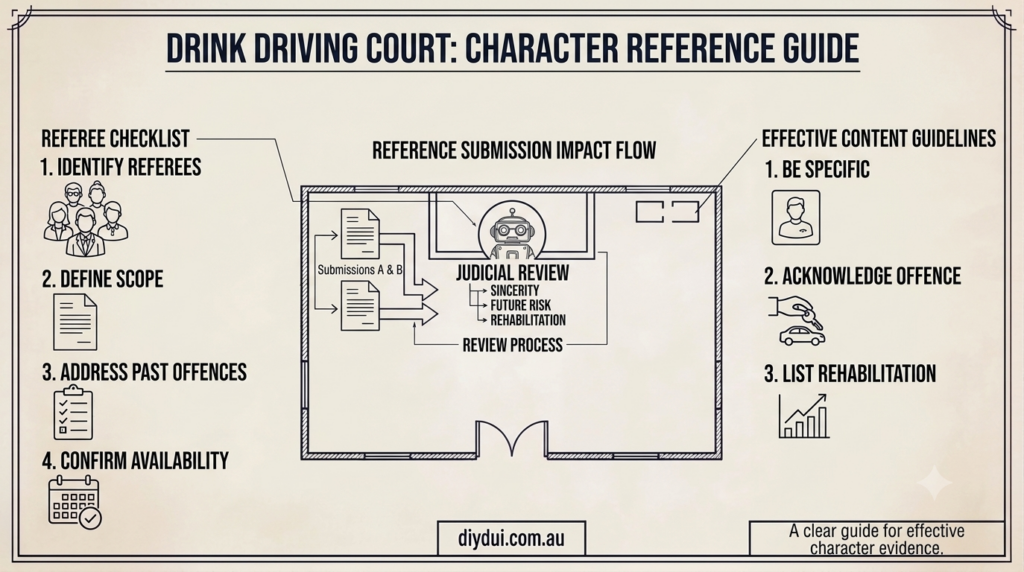
An effective character reference follows a clear, professional 5-paragraph structure:
Paragraph 1: Introduction
State your name, your relationship to the defendant, and how long you’ve known them. Example: “I am Sarah, the mother of Michael, and have known him for his entire life of 28 years.” Or: “I am John Smith, Operations Manager at ABC Engineering, and have worked with Michael for six years.”
Paragraph 2: Character Evidence
Provide specific, concrete examples of positive qualities and behaviour. Not abstract praise, but demonstrated evidence. Family members can speak to personal values, overcoming challenges, growth, and character development over time.
Paragraph 3: The Offence
Acknowledge the offence is serious while explaining how it’s inconsistent with their usual character. Family members can speak authentically to how this behaviour departs from who the person truly is.
Paragraph 4: Remorse & Rehabilitation
Provide evidence of remorse and steps taken toward rehabilitation or change. Family members are often the first to witness genuine remorse and can speak authentically to behaviour changes and commitments.
Paragraph 5: Conclusion
Conclude with a statement supporting consideration for sentencing leniency.
Total length: 250–400 words, professional tone, free of grammatical errors, signed and dated.
Common Mistakes to Avoid
Many people undermine their character references through correctable mistakes:
- ❌ Generic templates — Lacking specific examples or signed but undated
- ❌ Defending the behaviour — Never excuse or minimise the offence
- ❌ Too many references — More than 6–8 looks like overwhelming, not genuine
- ❌ Overly emotional language — Should be balanced, honest, professional
- ❌ Too brief (under 200 words) — Appears insufficiently considered
- ❌ Focus on job title instead of character — Courts want values, integrity, responsibility
How to Present References at Your Sentencing Hearing
On the day of your sentencing hearing, bring printed copies of all character references to hand to the prosecutor and magistrate. Typically, you’ll need:
- One copy for the prosecutor
- One copy for the magistrate
- One copy for the court file
The prosecutor will take them and pass them to the court. When you speak to the magistrate during the sentencing hearing, briefly reference them:
“Your Honour, I’ve prepared character references from people who know my character well—including family members and others in my life—and who can speak to the person I am beyond this single incident. I respectfully ask that you consider them as part of my submissions.”
Keep your comment brief and don’t read them aloud or elaborate excessively—let the references speak for themselves.
How Character References Influence Sentencing
Character references directly influence sentencing by demonstrating to the magistrate that you are a person of good character whose offence was uncharacteristic and that you have genuine rehabilitation prospects.
Magistrates in NSW use sentencing principles under the Crimes Sentencing Procedure Act 1999 which explicitly require consideration of:
- Personal background and character
- Prospects for rehabilitation
- Prior criminal history
- Level of remorse
- Any other matters the court considers relevant
Strong character references address all of these factors. References from family members can be particularly powerful because they demonstrate deep, lifelong knowledge of the defendant and can speak authentically to personal character development, values, and genuine remorse that family members are uniquely positioned to witness.
When a magistrate sees that someone has maintained strong family bonds, earned the respect and trust of close relatives, and receives heartfelt character evidence from family attesting to their genuine remorse and rehabilitation prospects, this carries significant weight in sentencing.
✓ Potential Outcomes:
Strong character references (including from family) can result in: reduced fines, shorter licence disqualification periods, and in exceptional cases with multiple strong references plus other mitigation, possibly consideration of s.10 dismissal without conviction (rare).
Frequently Asked Questions
Q: How many character references do I need for NSW court?
Aim for 3–6 strong references. Quality is far more important than quantity. One exceptional reference from a highly credible source is better than six mediocre ones. Three strong references from diverse sources (such as a family member, a professional contact, and a community reference) is often ideal.
Q: Can family members and close relatives provide character references?
Absolutely. Family members and close relatives are excellent sources of character references. They often have the deepest knowledge of who you are, can speak authentically to your personal character development, struggles, achievements, and values. A heartfelt, specific reference from a parent, sibling, grandparent, or close relative that provides concrete examples can be highly persuasive. Combine family references with professional or community references for a balanced approach.
Q: What if I don’t have professional contacts?
Family and close relative references are sufficient. References from family members who can speak authentically about your character are valuable. Additionally, seek references from community contacts such as sports coaches, community volunteers, religious leaders, neighbours, or people from clubs or associations you’re involved with. The key is that they can speak credibly about your character with specific examples.
Q: Should the reference mention the drink driving offence?
Yes, briefly and honestly. The referee should acknowledge that the offence is serious (never minimise it), explain their view of your character generally, and note that the behaviour is inconsistent with the person they know. Never excuse the behaviour, but contextualise it within the broader picture of your character and life. Family members can be particularly powerful here, speaking to how this behaviour departs from the person they know intimately.
Q: When should I start collecting references?
Start immediately after your first court appearance. You’ll typically have 4–8 weeks before your sentencing hearing. Contact referees early—give them 3–4 weeks to write and return the reference. Collecting references at the last minute results in rushed, weak references that undermine your case.
Q: How much weight do magistrates give to character references?
Magistrates consider character references as an important part of the overall mitigation case. Strong references demonstrating genuine remorse, good pre-offence character, and rehabilitation prospects can result in lower fines or shorter licence disqualification periods. Family references that authentically speak to personal character and genuine remorse carry significant weight.
Start Your Court Preparation Today
Need Help Preparing Character References for NSW Court?
The DIY DUI Method provides detailed guidance on gathering, writing, and presenting character references that positively influence magistrate decisions.
The DIY DUI Method provides detailed guidance on gathering, writing, and presenting character references that positively influence magistrate decisions. Whether from family members, professional contacts, or community sources, strong character evidence can be the difference between a harsh outcome and a fair one.
Legal Disclaimer
Disclaimer: This information is provided for educational purposes and is not legal advice. The DIY DUI Method does not constitute a legal service. While we strive to provide accurate information about drink driving law in NSW, court procedures are complex and circumstances vary significantly between cases. This content should not be relied upon as a substitute for professional legal advice. If you’re facing a drink driving charge, particularly if it’s a serious matter, involves repeat offences, professional licences, or other aggravating factors, we strongly recommend consulting with a qualified drink driving lawyer who can advise on your specific circumstances. Your specific situation may have legal complexities not covered in this general educational material. The information contained herein is accurate to our best knowledge as at the date of publication but may change as case law and legislation evolve.