Queensland Traffic Offender Program (Qld TOP): Complete Guide
If you’ve been charged with drink driving in Queensland, completing the Qld TOP before your court date is one of the most effective steps you can take. This guide explains exactly what the Queensland Traffic Offender Program is, how to enrol, what happens in the sessions, and how it affects your outcome at Magistrates Court.
The Queensland Traffic Offender Program — known as the Qld TOP — is a behaviour change and education program for people who have been charged with serious traffic offences, including all categories of drink driving. It is run by approved providers across Queensland and has been recognised by courts for many years as a meaningful indicator of remorse and rehabilitation.
This guide covers everything you need to know: what the Qld TOP involves, how to find a provider, what to expect from sessions, how to use your certificate in court, and the mistakes that can undermine the benefit of completing it.
What Is the Qld TOP?
The Queensland Traffic Offender Program is a structured, group-based education program designed for people charged with traffic offences including drink driving, drug driving, and driving disqualified. It was developed in response to data showing that many repeat traffic offences — and particularly drink driving — result from a combination of poor decision-making habits, underestimation of impairment, and insufficient understanding of real consequences.
The program is not a punishment. It does not add to your sentence. It is an education tool — and completing it before court is one of the clearest demonstrations you can give a magistrate that you are taking the charge seriously and doing something constructive about it.
The Qld TOP is approved by the Queensland Government and is administered by approved providers throughout the state. Providers range from community organisations and justice services to private providers and TAFE. Not all providers operate everywhere, so you’ll need to check availability in your area.
What the Qld TOP Covers
The program is built around three core themes that apply directly to drink driving cases:
- The real consequences of traffic offences — statistics, case studies, and personal accounts that connect participants to the genuine human impact of drink driving on drivers, passengers, families, and bystanders
- How alcohol and drugs impair driving — the science behind impairment, why people systematically underestimate their BAC and its effect on reaction time, perception, and judgment, and why “feeling fine” is not a reliable indicator
- Behaviour change and planning — practical strategies for decision-making before and during drinking situations, how to use alternatives to driving, and how to develop habits that prevent reoffending
Sessions are delivered in a group format, usually involving 8 to 15 participants. Facilitators are trained professionals. The environment is supportive and reflective — not punitive. Many participants report that the Qld TOP is more impactful than they expected, particularly the content about impairment science.
How the Qld TOP Compares to Other State Programs
Each state runs its own traffic offender program. If you were charged in Queensland, you need the Qld TOP — not the NSW Traffic Offender Program or any other state’s program. Completing another state’s program will not be recognised as equivalent by a Queensland magistrate.
| State | Program Name | Self-Enrol? | Court-Ordered? |
|---|---|---|---|
| Queensland | Queensland Traffic Offender Program (Qld TOP) | Yes | Can be either |
| NSW | Traffic Offender Program (TOP) | Yes | Can be either |
| Victoria | Traffic Offender Program (TOP) | Court-preferred | Typically court-linked |
Always check that the provider you’re enrolling with is an approved Queensland Qld TOP provider. An unapproved course won’t produce a certificate that courts recognise.
How to Enrol in the Qld TOP
Enrolling is straightforward. The most important thing is to start the process as early as possible after being charged. Here’s the process:
- Find an approved Qld TOP provider. Search for Queensland Traffic Offender Program providers in Queensland. You can find a list via the Queensland Government website or by calling your nearest court registry. Check that the provider is specifically approved to deliver the Qld TOP — not just a general driver education course.
- Confirm your court date first. Know when you’re appearing in Magistrates Court before you enrol, so you can choose an intake that finishes before — or as close to — your court date as possible. A completion certificate is always better than an enrolment letter, but both carry weight.
- Register and pay any fees. Qld TOP providers charge a fee for participation. The cost varies by provider. Financial hardship assistance may be available — ask at the time of enquiry if cost is an issue.
- Attend every session. Missing sessions risks not receiving your completion certificate. If you have a genuine conflict, contact your provider well in advance to discuss make-up options.
- Collect your completion certificate. Once you’ve completed all sessions, your provider will issue a certificate. This is the document you bring to Magistrates Court. Keep a copy for yourself.
Key point: You do not need a court order to enrol. Self-enrolling before your court date — without being told to — is significantly more impressive to a magistrate than completing it after being ordered to. It shows that you took personal initiative to address the problem.
What Happens in Qld TOP Sessions?
The standard Qld TOP runs over 8 weekly sessions of approximately 2 hours each. Here’s what you can expect:
Weeks 1–2: Road Trauma and Consequences
Early sessions focus on the real-world impact of drink driving. This typically includes statistics on drink driving fatalities and serious injuries in Queensland, case studies of actual incidents, and in some programs, personal accounts from people affected by traffic trauma — survivors, families, emergency responders.
This content is deliberately confronting. Its purpose is to replace the abstract sense that “drink driving is dangerous” with a concrete, personal understanding of what it actually costs.
Weeks 3–4: How Alcohol Impairs Driving
These sessions address the science of alcohol impairment. Most participants are surprised by two things: how early impairment begins (before the legal limit), and how unreliable self-assessment is when intoxicated.
The “I feel fine” problem — where people who are significantly impaired feel capable of driving — is central to this content. Understanding why this happens is one of the most practically useful things the Qld TOP teaches, because it directly addresses the thought process that led to the offence.
Weeks 5–6: Decision-Making and Risk
These sessions explore the decision-making process around alcohol and driving. Participants examine their own thinking on the night of their offence — not as an interrogation, but as a structured reflection. Common patterns emerge: minimising risk, social pressure, underestimating the distance to drive, overconfidence about BAC metabolism.
The facilitator guides group discussion about how to identify and interrupt these patterns before they lead to another offence.
Weeks 7–8: Planning and Alternatives
Final sessions focus on practical strategies: how to plan social situations involving alcohol, how to make alternatives to driving feel genuinely practical (not just a theory), and how to maintain commitment to a zero-drink-drive rule in real-world situations. Some programs include a personal commitment exercise.
The Group Setting
One concern people have about the Qld TOP is being in a group. The reality is that the group format is one of the most effective things about it. Everyone in the room is there for similar reasons. The shared experience creates a level of honesty that individual sessions often don’t. Facilitators are not there to punish or lecture — they guide and facilitate.
Most participants report that the Qld TOP is more impactful than they expected. The session content genuinely changes how people think about drink driving, which is both the program’s goal and the reason magistrates take it seriously.
How the Qld TOP Affects Your Court Outcome
This is what most people charged with drink driving really want to understand. The honest answer: the Qld TOP won’t make your penalty disappear, but it can genuinely improve your outcome — particularly on disqualification length and in cases where a non-conviction order is possible.
Why Magistrates Care
A Queensland magistrate sentencing a drink driving matter is trying to assess several things:
- How serious is the offence? (BAC level, circumstances, history)
- Does the person understand the danger they created?
- Are they genuinely remorseful?
- What is the realistic risk of reoffending?
Completing the Qld TOP addresses the last three directly. It provides concrete, documented evidence — not just verbal assurances — that you took the charge seriously enough to enrol in an education program before being required to. That distinction is what makes it effective.
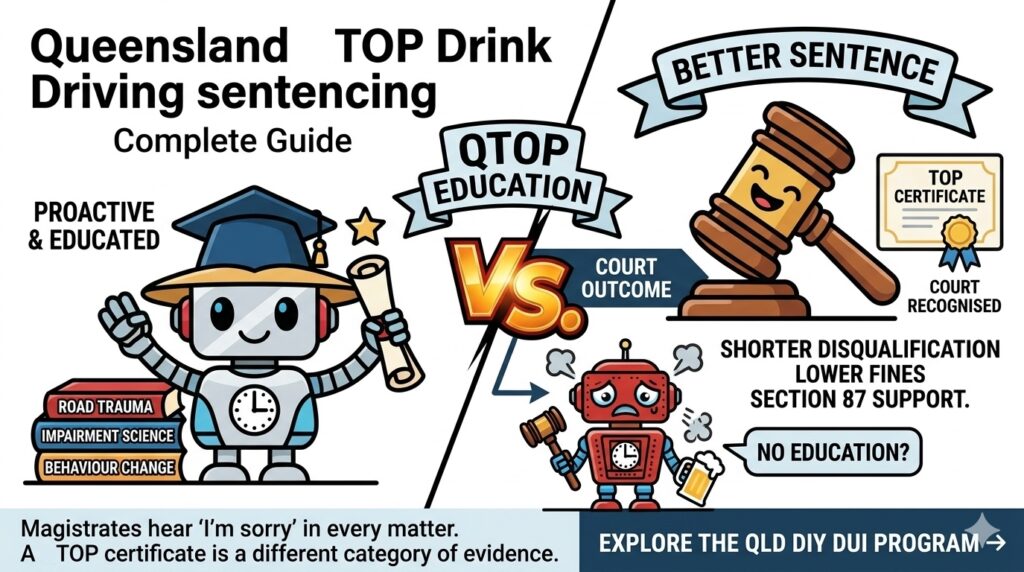
The difference between saying it and showing it: Magistrates hear “I’m sorry and I won’t do it again” in every drink driving matter. A Qld TOP certificate, combined with being able to speak specifically about what you learned, is a different category of evidence. It shows that your remorse led to action.
Practical Impact on Sentencing
Shorter disqualification
Where magistrates have discretion on the disqualification period, Qld TOP completion is a key mitigating factor. It is specifically relevant to the question of whether the minimum disqualification is appropriate.
Non-conviction / section 19 orders
In appropriate cases (first offences, lower BAC, strong personal circumstances), Qld TOP completion strengthens an application for a non-conviction order under section 19 of the Penalties and Sentences Act 1992.
Section 87 work licence
For section 87 restricted work licence applications, Qld TOP completion is specifically assessed as part of the “fit and proper person” test. It is essential to have completed or be completing it if you’re seeking a work licence.
Fine amount
Magistrates may exercise discretion to reduce fine amounts where there is genuine evidence of remorse and proactive rehabilitation steps. Qld TOP completion contributes to this picture.
The Qld TOP and Section 87 Work Licence Applications
This is worth expanding on specifically, because many Queensland drink drivers in employment-sensitive situations apply for a section 87 restricted work licence under the Transport Operations (Road Use Management) Act 1995.
Under a section 87 application, the magistrate must be satisfied that you are a “fit and proper person” to hold a restricted licence during the disqualification period. Completing the Qld TOP — and being able to speak to what you learned — is a significant component of satisfying that test. Magistrates will look unfavourably on a section 87 application where the applicant has not enrolled in the Queensland Traffic Offender Program or has made no effort to engage with rehabilitation.
If you’re applying for a section 87 work licence, treat Qld TOP completion as mandatory, not optional.
Qld TOP Availability Across Queensland
The Qld TOP is available across the state, but availability varies by region and provider. Here’s a practical overview:
South East Queensland
Multiple providers operate in Brisbane, Gold Coast, Sunshine Coast, Logan, Ipswich, Toowoomba, and surrounding areas. Intakes are usually frequent — weekly or fortnightly starts in metropolitan areas. This is the easiest region for enrolment and timely completion.
Regional Queensland
Providers operate in most regional centres including Cairns, Townsville, Mackay, Rockhampton, Bundaberg, and Hervey Bay. Intake frequency varies — in some centres there may be a wait of several weeks for the next available intake. Contact providers early to check current availability.
Outback and Remote Queensland
In very remote areas, in-person Qld TOP delivery may not be available. Options include:
- Online or blended delivery — some providers offer online Qld TOP formats; confirm these are approved and produce a recognised certificate
- Travel to a regional centre — for important court matters, some participants travel to a nearby regional provider
- Adjournment request — if no practical option is available before your court date, you can seek an adjournment from the magistrate to allow time to complete the program
How to Use Your Qld TOP Certificate in Court
Getting the most out of your Qld TOP certificate in court is a matter of practical execution. Here’s how to do it properly:
Before the hearing: Arrive at Magistrates Court at least 20–30 minutes early. Hand a copy of your Qld TOP certificate to the court staff at the registry counter, or to the police prosecutor, before your case is called. This allows the magistrate to have it in front of them when your matter is dealt with. Don’t wait until you’re in the dock.
When you address the court: After the police present the facts, the magistrate will ask if you want to say anything. Mention the Qld TOP: “Your Honour, I have completed the Queensland Traffic Offender Program and I have handed a copy of the certificate to the court.” Then say briefly — in one or two sentences — what you found most meaningful about the program. Specificity matters more than length.
Don’t over-explain: A calm, concise reference to the Qld TOP with one specific insight you took from it is more effective than a lengthy account. The certificate is doing the work — you’re just confirming it was a genuine experience, not just a box-tick.
Example: “Your Honour, I completed the Queensland Traffic Offender Program before today. The part that stayed with me most was the session on how alcohol impairs judgment before you feel impaired — I genuinely didn’t understand that before, and it’s something I think about differently now.”
Qld TOP Combined With Other Mitigating Steps
The Qld TOP is most powerful when it’s part of a broader picture of genuine rehabilitation. Other steps that work well alongside it:
A well-written apology letter. A letter to the magistrate that explains your circumstances honestly, acknowledges the seriousness of what you did, and commits to future behaviour is a strong document — particularly when it references what you learned in the Qld TOP.
Character references. Letters from employers, family members, or community members who can speak to your character and — where relevant — the practical consequences of a disqualification add depth to your case.
Counselling or support engagement. For offences above low range, or for cases involving patterns of alcohol use, engaging with a GP, counsellor, or support service is an additional signal to the magistrate. It’s not required, but for higher-range matters it can make a meaningful difference to outcomes.
An early guilty plea. An early plea demonstrates acceptance of responsibility and saves court time. Queensland courts discount sentences for early guilty pleas. Combined with the Qld TOP, an early plea creates a strong mitigating package.
Quick Reference Summary
| Detail | Information |
|---|---|
| Program name | Queensland Traffic Offender Program (Qld TOP) |
| Jurisdiction | Queensland only |
| Approved by | Queensland Government |
| Duration | Typically 8 weekly sessions (~2 hours each) |
| Self-enrol? | Yes — no court order required |
| Best time to enrol | As early as possible after being charged |
| Certificate? | Yes — bring to Magistrates Court |
| Sentence impact | Recognised mitigating factor — supports lower disqualification, non-conviction orders, section 87 work licence applications, and fine reduction |
Frequently Asked Questions
What is the Queensland Traffic Offender Program (Qld TOP)?
The Qld TOP is an education and behaviour change program for people charged with drink driving and other serious traffic offences in Queensland. It involves group sessions covering road trauma consequences, how alcohol impairs driving, and strategies to avoid reoffending. It is approved by the Queensland Government and produces a certificate of completion that courts recognise as a mitigating factor.
How do I enrol in the Qld TOP?
Contact an approved Qld TOP provider in your area. No court order is required. You can find providers through the Queensland Government website or by asking the court registry. Enrol as early as possible after being charged so you can complete the program before your court date.
Does the Qld TOP reduce my drink driving sentence?
Completing the Qld TOP is a recognised mitigating factor in Queensland Magistrates Court sentencing. It doesn’t guarantee a specific reduction, but magistrates view it favourably — particularly when combined with an early plea, a good personal history, and other mitigating steps. It is especially important for section 87 work licence applications.
How long does the Qld TOP take?
The standard Qld TOP involves 8 weekly sessions of approximately 2 hours each, running over 8 weeks. Some providers offer alternatives. Check with your chosen provider for current intake schedules and format options.
Do I need a court order to do the Qld TOP?
No. Self-enrolling before your court date — without being ordered to — is the most effective approach. It demonstrates personal initiative and genuine remorse rather than mere compliance.
Is the Qld TOP available online?
Some providers offer online or blended formats. Make sure any online Qld TOP you enrol in is delivered by an approved provider and produces a Queensland-recognised certificate of completion. Confirm this before enrolling.
What if I can’t finish before my court date?
You can ask the magistrate to adjourn your matter to allow you to complete the Qld TOP. This is a common and routinely granted application. A letter from your provider confirming enrolment and active participation may carry some weight in the meantime.
Does the Qld TOP help with a section 87 work licence application?
Yes. Qld TOP completion is specifically relevant to the “fit and proper person” test in section 87 work licence applications. Magistrates will view a section 87 application much more favourably where the applicant has completed — or is completing — the Queensland Traffic Offender Program.
Preparing Your QLD Drink Driving Case?
Use your Qld TOP certificate in a prepared guilty plea.
The DIY DUI program gives you everything you need — how to write an apology letter, what to say in court, how to use your Qld TOP certificate effectively, and how to prepare a strong submission for your magistrate.