First Offence Drink Driving NSW: What Are Your Options?
If you’ve been charged with drink driving for the first time in NSW, you’re probably asking yourself: What happens now? Could I go to jail? Will I lose my job? Do I have any way out of this?
The good news is that first-time drink driving offenders in NSW have more options than many people realise. You’re not automatically doomed to a harsh penalty. What matters is understanding your legal position, knowing what options are available to you, and making informed decisions early.
This comprehensive guide walks through every option available to you as a first-time drink driver in NSW — from fighting the charge to negotiating the best possible outcome if you do plead guilty. You’ll learn exactly what you’re facing and what paths are available to you.
Do You Actually Have a Defence?
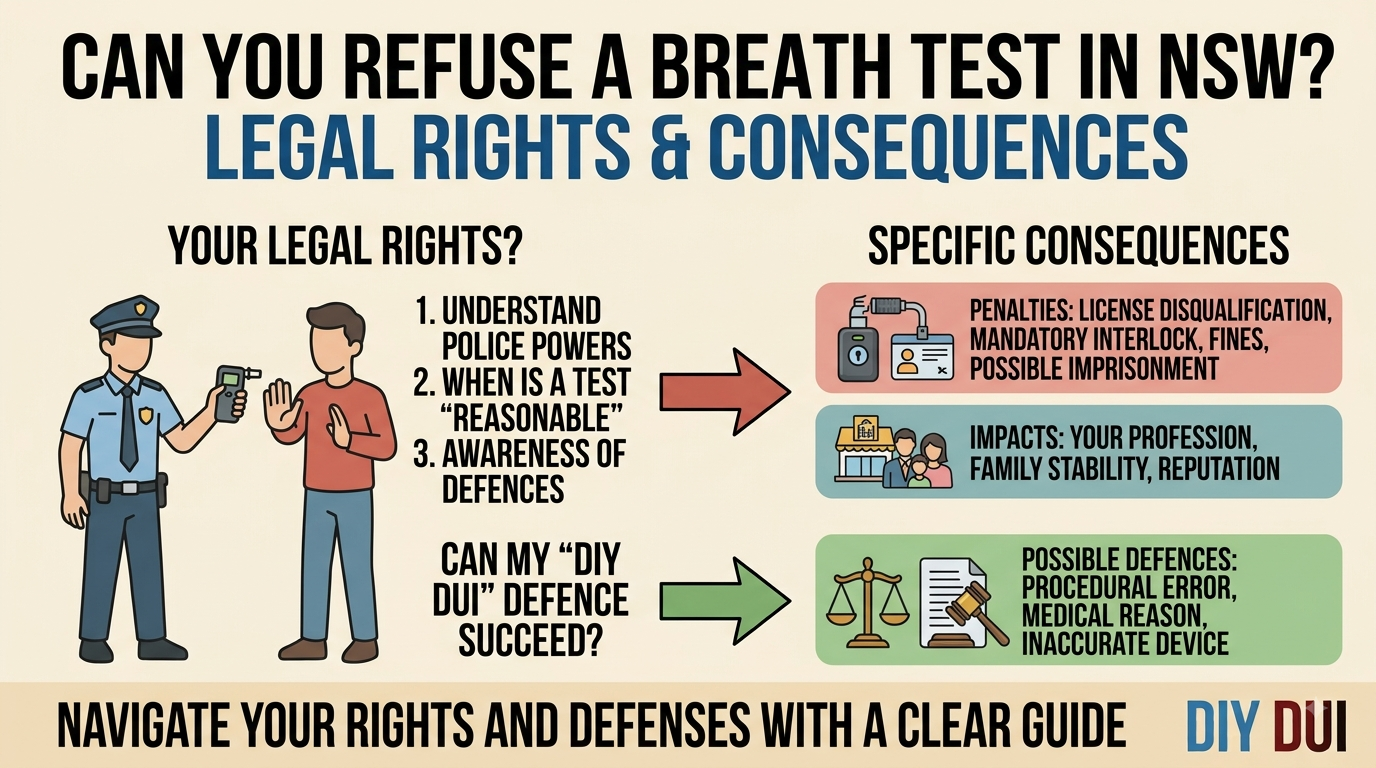
Before considering any other options, you need to answer one critical question: do you have a legitimate legal defence to the charge?
Most people assume they don’t. But there are genuine defences to drink driving charges that police and prosecutors get wrong more often than you’d think. Even if you know you were over the limit, procedural errors could invalidate the charge.
Common Drink Driving Defences in NSW
1. Faulty Breath Test Procedure
Police must follow strict legal procedures when conducting breath tests. Common errors that can invalidate results include:
- The 20-minute rule: Police must wait 20 minutes between your initial breath test and the confirmatory test. If they don’t, results may be inadmissible.
- Mouth contamination: Police must check you haven’t eaten, drunk anything, or used mouthwash in the 20 minutes before testing. If they skip this check, a positive reading could be false.
- Device inspection: You have the right to inspect the breathalyser device before testing. If police don’t allow this, it’s a procedural breach.
- Device calibration: The breathalyser must be properly calibrated and maintained. If the device wasn’t serviced recently or records show calibration issues, results may be challenged.
Expert source: NSW Local Court – Drink Driving Procedures
If police didn’t follow procedure, the test results may be inadmissible in court, and the charge could be withdrawn.
2. “Not in Charge” Argument (Exceptional Cases)
In rare circumstances, you might argue you weren’t legally “driving” or “in charge” of the vehicle. For example:
- You were parked, asleep in your car, with no intention to drive (this is a genuine defence in rare cases)
- You were not the driver but were charged anyway due to police misidentification
- You were towed away (you cannot be “in charge” of a towed vehicle)
This defence is difficult and fact-specific, but it occasionally succeeds.
3. Medical Defence (Very Rare)
If you can prove you had a medical condition or took prescribed medication that caused you to fail the breath test, this might be a defence. You’d need medical evidence from a specialist doctor.
Important: Only plead guilty if you genuinely accept that you committed the offence. If you believe you have a defence or the police evidence is flawed, seek legal advice before entering a plea.
Your Three Main Options as a First-Time Offender
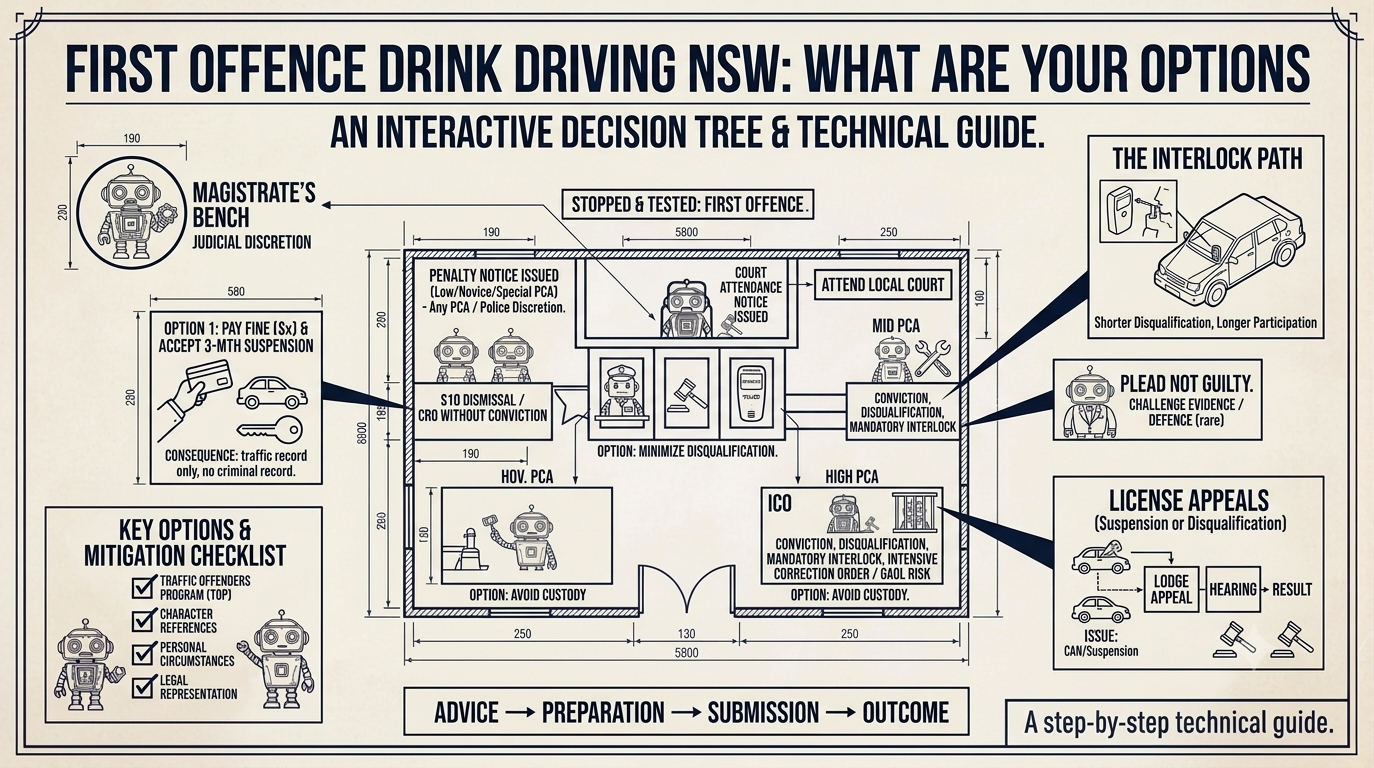
If you don’t have a strong defence, you have three main strategic paths forward. Each has different risks, costs, and outcomes.
Option 1: Fight the Charge (Plead Not Guilty)
What it means: You plead not guilty and force the prosecution to prove the charge at a Local Court hearing or District Court trial. The burden of proof is on them.
A Word of Caution: Drink driving in NSW is generally a strict liability offence. Unlike most criminal charges, the onus of proof shifts — it is you who must prove you are not guilty, rather than the prosecution proving you are. This makes these charges notoriously difficult to defend. If your defence fails, the court will not apply the leniency or sentence discounts available for an early guilty plea, and the penalties imposed are typically much higher. Before pursuing this path, get an honest assessment from an experienced lawyer.
Pros: If you win, charge dismissed completely • Keeps options open • Time to gather evidence • Assess police procedure
Cons: Costs $3,000–$8,000+ • Takes 2–6 months+ • If you lose, harsher penalties possible • High stress and uncertainty • No sentence discounts apply
When this makes sense: You have a genuine, credible defence • Independent witnesses support your account • Police procedure was seriously flawed • You can afford quality legal representation
Option 2: Negotiate the Facts or Charges
What it means: An experienced lawyer reviews the police evidence and may ask the prosecutor to amend the agreed facts, accept a less serious charge, or withdraw a charge where there is a proper legal or evidentiary basis.
Reality: These negotiations are difficult and often do not succeed. The prosecutor is not required to agree, and a request based only on personal circumstances or a desire for a lighter penalty is unlikely to be enough. Many matters continue on the original facts and charges.
Not a DIY option: Effective negotiation usually requires detailed analysis of the brief of evidence, identification of a genuine weakness or dispute, and persuasive written submissions. If you want to explore this path, you should obtain assistance from an experienced NSW drink driving lawyer.
Option 3: Plead Guilty and Present Your Best Case
What it means: You accept responsibility, plead guilty early, and focus entirely on presenting circumstances and evidence that minimise your penalty.
Pros: Early guilty plea taken into account and can reduce the penalty • Certainty of outcome • Lower legal costs ($1,500–$3,500) • Quicker resolution (4–8 weeks)
Cons: Results in criminal conviction • Automatic licence disqualification • Fine and penalties • Criminal record affects employment
When this makes sense: No credible defence (police procedure proper, BAC clearly over limit) • Ready to take responsibility • Willing to prepare thoroughly • Want certainty rather than months of stress
Which Option Should You Choose? A Decision Framework
Choosing the right path depends on three critical factors:
Factor 1: Do You Have a Genuine Defence?
Be brutally honest with yourself (or get a lawyer’s view). Ask:
- Did police follow proper breath test procedures?
- Are there witnesses who support your account?
- Could there be a medical explanation?
- Is there any evidence police made errors?
If YES and the defence is credible, fighting the charge makes sense (Option 1).
If NO, spend your energy on Options 2 or 3 instead.
Factor 2: What Was Your BAC Level?
| BAC Level | Recommended Approach | Why |
|---|---|---|
| Low-range (0.05 to less than 0.08) | Guilty plea with strong preparation | Penalties are generally lower than for higher-range offences; preparation and mitigation remain important |
| Mid-range (0.08–0.149) | Guilty plea with strong preparation | Mandatory interlock applies; fighting becomes riskier; focus on mitigation |
| High-range (0.15+) | Guilty plea with top-quality preparation | Fighting is risky; harsher penalties likely regardless; focus on minimising damage |
Factor 3: What’s Your Situation?
Consider your specific circumstances:
- Professional licence at stake? (doctor, lawyer, pilot, truck driver) → Obtain experienced legal advice about any defence, negotiation or plea strategy
- Career-critical job? → Get advice early about employment consequences and focus on presenting the strongest available case
- Recent personal crisis? (loss, mental health, family breakdown) → These are powerful mitigation factors in sentencing
- Clean record otherwise? → Courts view this favourably in sentencing
- Can you afford quality legal help? → Yes = more options; No = focus on preparation and self-representation
NSW First-Offence PCA Penalty Settings
The table below summarises published NSW settings for first-offence prescribed concentration of alcohol (PCA) matters. It is general information only. The applicable pathway can depend on the charge, driver category and whether police issue a penalty notice or the matter is dealt with by a court.
| Offence Type | Fine | Jail | Min Disqualification | Max Disqualification | Interlock |
|---|---|---|---|---|---|
| High Range (0.15 or above) | $3,300 | 18 months | 12 months | Unlimited | Yes |
| Mid Range (0.08 – less than 0.15) | $2,200 | 9 months | 6 months | Unlimited | Yes |
| Low Range (0.05 – less than 0.08) | $2,200 | Nil | 3 months | 6 months | No |
These are published first-offence PCA settings, not a prediction of any individual result. Driving under the influence, refusing a test, and combined alcohol-and-drug offences have different penalty frameworks. Check the official NSW Government information for current details.
Where to Get Professional Help
Free Legal Advice
- Legal Aid NSW — May cover a lawyer if you qualify financially.
- Law Access NSW — Free telephone legal information: 1300 888 529
- Local Court Duty Solicitor — Free on-the-day advice available at court (limited availability).
Paid Legal Representation
Most drink driving lawyers in NSW offer:
- Free 30-minute initial consultation (no cost to assess your case)
- Flexible payment plans (monthly instalments)
- Fixed fees for guilty plea cases (often $1,500–$3,500 total)
- Unbundled services (you represent yourself but get specific help from lawyer on key areas)
Compare 3–4 lawyers before choosing. Ask about their experience with first-time offenders and their approach to your specific BAC level.
Recommended Traffic Offender Programs (NSW)
Completing a traffic offender program before court is one of the most powerful steps you can take. It demonstrates genuine remorse and commitment to change. Approved programs include:
- PCYC Traffic Offender Intervention Program — Evidence-based, widely respected by courts
- SAVE Traffic Offender Program — Traffic offender education program
- Road Sense Australia — Comprehensive program with good outcomes
- ASPIRE Traffic Offender Program — Focus on behaviour change
Costs: Usually $200–$500, takes 1–4 weeks to complete. Do this before your court date and bring the certificate with you.
Frequently Asked Questions
Will I definitely lose my job?
Not necessarily. Most employers understand that a single drink driving conviction, handled professionally and followed by genuine rehabilitation, doesn’t mean you’re unfit for employment. Much depends on your industry and role, whether driving is essential, and how you handle it.
Can I get a Section 10 (conviction not recorded)?
Possibly, but it’s not guaranteed. A Section 10 order is possible, especially for a low-range first offence; the court weighs the factors in section 10(3) of the Crimes (Sentencing Procedure) Act 1999, such as your character, antecedents, the trivial nature of the offence and the extenuating circumstances. Learn more about Section 10 dismissals.
How long does the court process take?
- Guilty plea: 4–8 weeks from first mention to sentencing
- Trial/negotiation: 2–6 months or longer
What’s the difference between licence disqualification and an interlock?
- Licence disqualification = You cannot drive at all for a set period. Court-imposed.
- Interlock device = Device fitted to your car requiring breath test before engine starts. Mandatory for mid-range and high-range offences: at least 12 months for a first mid-range offence and 24 months for a first high-range offence. You can drive with device installed.
Can I appeal if I don’t like the penalty?
Yes, but appeals are complex and have strict time limits (usually 28 days). You should seek legal advice immediately if considering an appeal. Success is not guaranteed and costs time and money.
Ready to Take Control of Your Case?
Being charged with drink driving for the first time is a wake-up call, but it doesn’t have to be a life-defining event. What you do now — the decisions you make in the next week or two — will significantly determine your outcome.
Your three critical steps:
- Get professional legal advice (even if just for a free 30-minute consultation) to assess your specific circumstances
- Honestly evaluate whether you have a defence (or ask a lawyer to assess this)
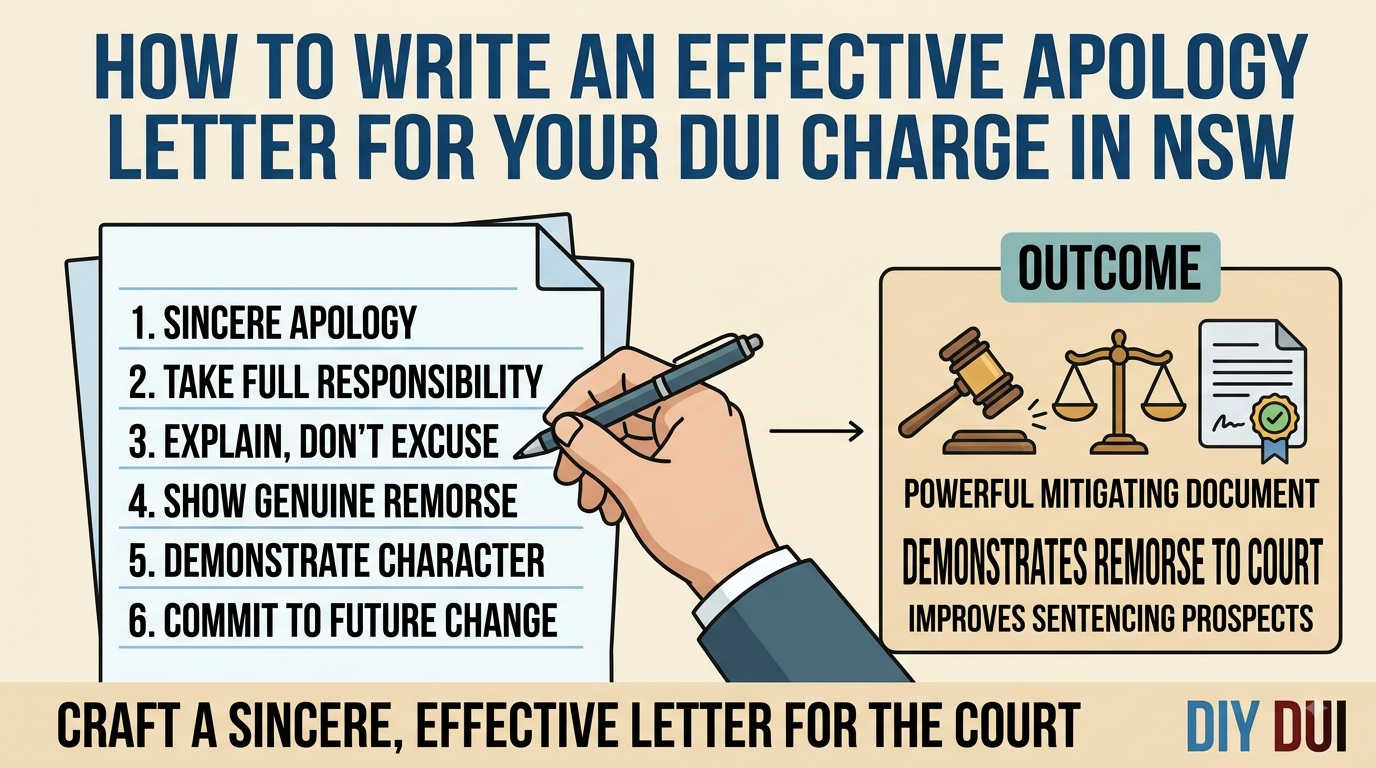
- Start preparing immediately if you’re likely to plead guilty (character references, traffic offender program, apology letter)
Don’t delay. The longer you wait, the fewer options remain available.
Ready to Master Your DUI Defence Case?
Your first drink driving charge doesn’t define your future. But taking control of your defence will.
The NSW DIY DUI Program provides structured, step-by-step guidance and tools for first-time offenders navigating their DUI charges. Access templates, checklists, and proven strategies for your specific situation.