Complete Guide to NSW Traffic Offender Programs (TOP)
If you’ve been charged with drink driving in NSW, completing a Traffic Offender Program (TOP) before your court date is one of the most effective steps you can take to improve your outcome at sentencing.
The TOP is a structured education and behaviour change program designed for people charged with serious traffic offences. It’s not a punishment — it’s a course. And the certificate you receive when you complete it is one of the most valuable documents you can hand to a NSW magistrate on the day of your hearing.
This guide explains what the program involves, why courts value it so highly, and how to find and enrol in a program that suits your situation in NSW.
What Is the NSW Traffic Offender Program?
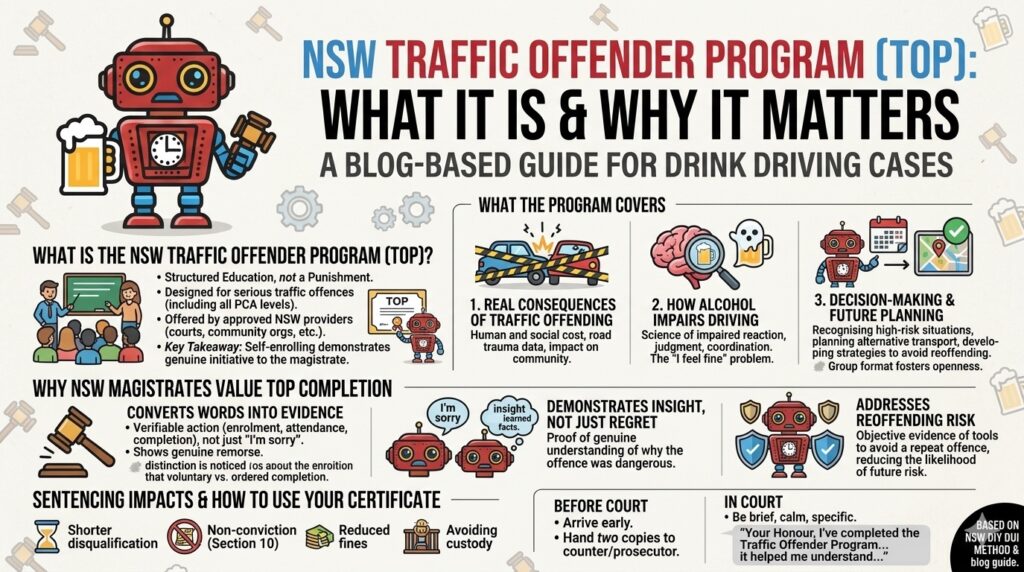
The Traffic Offender Program is a recognised education program for people charged with serious traffic offences in NSW — including all categories of drink driving from low-range through to high-range PCA. It is offered by a range of approved providers across the state: educational institutions, community organisations, and justice-related services.
The program is built around the idea that many traffic offences — especially drink driving — are not the result of deliberate recklessness, but of poor judgment, underestimated risk, and a lack of genuine understanding of how alcohol impairs the brain. The course addresses all of that directly.
Participants who complete the program receive a certificate of completion. That certificate is what you bring to court.
Is It Compulsory?
No — and that’s an important point. The Traffic Offender Program is not a mandatory condition of pleading guilty to drink driving in NSW. You are not required to complete it. A magistrate cannot order you to complete it as a condition of your sentence in most standard drink driving matters.
That’s exactly why completing it voluntarily — before court, on your own initiative — carries so much weight. The magistrate can see that you didn’t do it because you had to. You did it because you chose to.
Self-enrolling before court is more powerful than being ordered to complete it afterward. It demonstrates genuine remorse and initiative — not compliance. This distinction is noticed by magistrates.
What the Program Typically Covers
While delivery formats and providers vary, Traffic Offender Programs in NSW consistently cover three core areas. Understanding what you’ll be learning helps you engage with it properly — and helps you speak about it confidently in court.
1. The Real Consequences of Traffic Offending
This component examines the human and social cost of drink driving — road fatalities and serious injuries in NSW, the impact on families, and the broader community consequences. The goal is not to shame participants but to build a genuine, evidence-based understanding of why the offence is treated so seriously.
Many participants find this the most impactful part of the program — particularly content involving road trauma data or accounts from people affected by drink driving incidents.
2. How Alcohol Impairs Driving
This is where participants often encounter information that genuinely surprises them. The science of how alcohol affects reaction time, peripheral vision, judgment, and coordination — and how intoxication consistently feels less significant than it actually is — is one of the most common “I didn’t know that” moments in the program.
Understanding the “I feel fine” problem — why people consistently underestimate their impairment — is a key part of this module. It explains why even careful, responsible people end up over the limit.
3. Decision-Making, Self-Assessment, and Future Planning
The practical component focuses on building better habits going forward. This includes recognising high-risk situations, planning alternatives to driving after drinking, communicating limits in social settings, and developing personal strategies for avoiding reoffending.
Some programs include a reflective component — a written exercise or group discussion about participants’ own experience and what they would do differently. This is not interrogative. It’s designed to help you build genuine insight rather than just complete a course.
Format and Duration
Programs typically run over multiple weekly sessions — commonly between 6 and 10 hours of total contact time, delivered in a group setting. Some providers offer more intensive or condensed formats. Delivery can be in-person, blended, or — in some cases — online.
The group format is worth noting. Many participants are initially apprehensive about sharing a room with strangers who are all in the same situation. In practice, this tends to create a level of openness and honesty that makes the program more effective than an individual course would be. Facilitators are trained educators and counsellors — not magistrates, not police. Their job is to help, not to judge.
Why NSW Magistrates Value TOP Completion
When a magistrate sentences someone for drink driving in NSW Local Court, they’re working through a set of questions that go beyond “what did they blow?” They’re assessing the whole picture: the seriousness of the offence, the person’s insight into their behaviour, the likelihood of reoffending, and what the appropriate community response is.
A TOP completion certificate — particularly when you can speak to what you learned — directly addresses three of those four questions. Here’s why that matters.
It Converts Words Into Evidence
Magistrates hear “I’m really sorry, it won’t happen again” in virtually every drink driving case they hear. Those words, on their own, carry limited weight. They’re expected.
A completion certificate is different. It says: between being charged and appearing in court, this person identified a concrete program, enrolled in it, attended every session, and completed it. That’s a verifiable action. It demonstrates remorse through behaviour, not just through language.
The distinction magistrates notice: Being told to complete a program after sentencing carries much less weight than having already done it. If you walk into court with a certificate, you’ve demonstrated initiative. If the magistrate has to order you to do it, that’s compliance — not remorse.
It Demonstrates Insight, Not Just Regret
Courts distinguish between regret and insight. Regret is “I’m sorry I got caught.” Insight is “I now understand why what I did was genuinely dangerous, and I have learned specific things that will change my behaviour.” The TOP is designed to produce the second of those. When you can speak briefly and specifically about what the program taught you, it signals genuine insight — not just a prepared apology.
It Addresses Reoffending Risk
One of the magistrate’s core questions at sentencing is: is this person likely to reoffend? For first-time offenders especially, the answer to that question can make a significant difference to the penalty imposed. Completing a behaviour-change program — and being able to articulate what you learned — directly addresses this question. It provides objective evidence that you have tools to avoid repeating the offence.
How It Affects Sentencing in Practice
The TOP is a recognised mitigating factor in NSW drink driving sentencing. It doesn’t guarantee any specific outcome — magistrates have broad discretion and weigh all the circumstances. But in practice, completion of the program contributes to:
- Shorter disqualification periods — where the magistrate has discretion to set a period within a range, genuine rehabilitation evidence supports the lower end
- Non-conviction outcomes (section 10) — for first offenders with low BAC readings, the TOP is often a key factor in whether a magistrate considers dismissing the charge without recording a conviction
- Reduced fines — where magistrates exercise discretion on fine amount, a strong mitigation package including the TOP can support a lower figure
- Avoiding custody — for borderline mid-range and high-range first offences, demonstrating rehabilitation through the TOP can be the difference between a harsher and a more lenient outcome
How to Find a Program and Enrol
Traffic Offender Programs in NSW are offered by a range of approved providers. The best starting points for finding a program near you are:
- Your local court registry. Ask the registry staff at your NSW Local Court. They deal with these programs regularly and can direct you to approved providers in your area.
- Legal Aid NSW. Legal Aid can provide information on programs available in your region, particularly for regional and rural areas where options may be more limited. Visit legalaid.nsw.gov.au or call their helpline.
- Community organisations and educational providers. Programs are offered by a range of community organisations, traffic education services, and educational institutions across NSW — both metropolitan and regional.
- Online search. Searching “Traffic Offender Program NSW [your city or region]” will surface current providers. When contacting a provider, confirm that the program produces a recognised completion certificate before enrolling.
When to Enrol
As early as possible. Ideally, you should enrol as soon as you receive your charge — not when your court date is approaching. The goal is to complete the program and have your certificate in hand before you walk into court.
A full completion certificate is stronger than a letter showing you’ve enrolled but haven’t finished. That said, if your court date is imminent, a letter confirming active enrolment and participation — with a projected completion date — still carries weight. It’s better than nothing, and you can ask the magistrate for a short adjournment to complete the program if needed.
What to Confirm Before You Enrol
- Does the program produce a formal completion certificate that can be presented to NSW Local Court?
- What is the total duration and how many sessions are required?
- Can you complete it in full before your court date given the intake schedule?
- What is the cost, and is any financial assistance available?
How to Use Your Certificate in NSW Local Court
Getting the certificate is only half the job. Presenting it effectively on the day matters. Here’s how to do it properly.
Before Your Case Is Called
Arrive at court early. Before your case is called, hand a copy of your certificate to the court counter staff or to the police prosecutor. This gives them time to pass it to the magistrate so it’s already in front of them before your matter is heard. Don’t wait until you’re standing at the bar table to produce it — you want the magistrate to have had a chance to see it first.
Practical tip: Bring at least two printed copies of your certificate — one to hand to the court and one to keep. Also bring any character references, employer letters, or other supporting documents in a single organised folder. Being prepared and organised makes a positive impression before you even speak.
When You Address the Magistrate
After the police prosecutor reads out the facts, the magistrate will ask if you have anything to say. This is your opportunity. Keep it brief, calm, and specific. For example:
Example of what to say:
“Your Honour, I’ve completed the Traffic Offender Program and I handed a copy of the certificate to the court this morning. The program genuinely helped me understand how alcohol affects judgment in ways I hadn’t appreciated. I accept full responsibility for what happened and I’m committed to not putting myself or anyone else in that position again.”
One or two sentences about what you found meaningful in the program is enough. Specificity is better than length. You don’t need to give a speech — the certificate does most of the work. Your job is to confirm you engaged with it genuinely.
The TOP Works Best as Part of a Broader Preparation
The Traffic Offender Program is one piece of your mitigation — a very important piece, but still one piece. The strongest presentations at NSW Local Court combine several elements that together tell a coherent story: this person understands what they did, they’ve taken it seriously, and they’re not a risk to reoffend.
The TOP certificate combined with the following makes for a compelling package:
- A clear, honest plea in mitigation. A brief, calm explanation of the circumstances, genuine acceptance of responsibility, and a commitment to changed behaviour — delivered without excuses.
- Character references. One to three well-written letters from employers, community members, or people who know you well and can speak to your character. Quality matters more than quantity.
- Employment or hardship evidence. If your licence is essential for work or family responsibilities, a letter from your employer — or your own statement explaining the impact — helps the magistrate understand the full picture.
- Counselling or support engagement (where relevant). If your offence was connected to broader alcohol use patterns, engaging with a GP, counsellor, or community service before court reinforces the rehabilitation narrative.
Key Takeaway: The Traffic Offender Program won’t undo the charge. But it demonstrates something magistrates actively look for — that you took responsibility, sought out education, and did the work before you were required to. That matters. Combined with solid preparation across the rest of your case, it can make a genuine difference to your outcome.
Frequently Asked Questions About the NSW Traffic Offender Program
Q: Do I need a court order to enrol in the Traffic Offender Program?
No. You can enrol in the program without any court order or referral. In fact, self-enrolling before your court date — and completing the program before you appear — carries more weight with magistrates than being ordered to do it afterward. It shows initiative and genuine remorse rather than compliance.
Q: Will completing the program reduce my sentence?
It is a recognised mitigating factor in NSW sentencing for drink driving. It doesn’t guarantee any specific outcome — magistrates weigh all the circumstances — but completion of the TOP consistently supports lighter penalties, shorter disqualification periods, and in appropriate first-offence cases, can contribute to a magistrate considering a non-conviction outcome. It is one of the most practical and effective steps you can take.
Q: How do I find a Traffic Offender Program near me in NSW?
Start by asking at your local NSW Local Court registry — they regularly deal with these programs and can refer you to approved providers in your area. Legal Aid NSW can also help with referral information, particularly in regional areas. Searching “Traffic Offender Program NSW [your area]” online will surface current providers. Before enrolling, confirm the program produces a formal certificate recognised by NSW courts.
Q: How long does the program take?
This varies by provider. Most programs involve between 6 and 10 hours of contact time, typically delivered in weekly group sessions. Some providers offer more intensive formats. Confirm the duration with your chosen provider and make sure the schedule fits within your timeframe before your court date.
Q: What if my court date is very soon and I can’t finish the program in time?
Enrol immediately and get a letter from the provider confirming your active participation and expected completion date. This still carries weight at court. You can also ask the magistrate to adjourn your matter for a short period to allow you to complete the program — this is a common and reasonable application that magistrates generally grant for a first adjournment request.
Q: Is the program relevant for repeat offenders, or just first-time offenders?
It is relevant for both — but it’s arguably more important for repeat offenders. When a magistrate is sentencing someone for a second or subsequent drink driving offence, they are assessing whether this is a pattern that will continue. Demonstrating active engagement with a behaviour-change program is one of the strongest signals that the answer is no. The TOP is a significant piece of your mitigation regardless of your history.
Q: Does a Queensland Traffic Offenders Program count in NSW?
No. Each state runs its own program. If you were charged in NSW and are appearing in NSW Local Court, you need the NSW Traffic Offender Program. Completing a Queensland program will not be recognised as equivalent by a NSW magistrate. Make sure you enrol in the correct state’s program.
Q: Does completing the TOP affect the mandatory interlock period?
Completing the TOP does not directly reduce the mandatory interlock period — that is set by legislation and cannot be waived by a magistrate in most circumstances. However, it contributes to the broader rehabilitation picture that the magistrate considers when setting the overall sentencing package, including the disqualification period that precedes the interlock.
Important: If your matter is complex, you dispute police facts, or your situation falls outside what this program covers, you should consider speaking with an experienced traffic lawyer.
Ready to Prepare Your Full Case for Court?
The Traffic Offender Program is one piece of the puzzle.
The Traffic Offender Program is one piece of the puzzle. The NSW DIY DUI Plea Program guides you through the rest — what to say, what to bring, and how to walk into NSW Local Court prepared and confident.
Legal Disclaimer: The information on this page is general in nature and does not constitute legal advice. Laws and penalties can change. Always verify current information with official sources. DIY DUI is an information and preparation resource only.