Section 87 Work Licence QLD: How to Apply After DUI?
How to Apply for a Section 87 Work Licence After DUI in Queensland
If you’ve been disqualified from driving after a drink driving conviction in Queensland, but your job depends on your ability to drive, a section 87 restricted work licence might be an option. It’s not automatic, and the application process can feel daunting. This guide walks you through exactly what a work licence is, how to apply, what you need to prepare, and what happens at the hearing.
A section 87 work licence allows you to drive during your disqualification period, but only for work purposes. It’s not a full licence—there are strict conditions. But if you’re eligible and your application succeeds, it can allow you to keep your job and continue earning income while you serve your disqualification period.
What Is a Section 87 Restricted Work Licence?
A section 87 work licence is a restricted licence issued under section 87 of the Transport Operations (Road Use Management) Act 1995 (Queensland). It allows you to drive a motor vehicle during a period of licence disqualification, but only for work purposes.
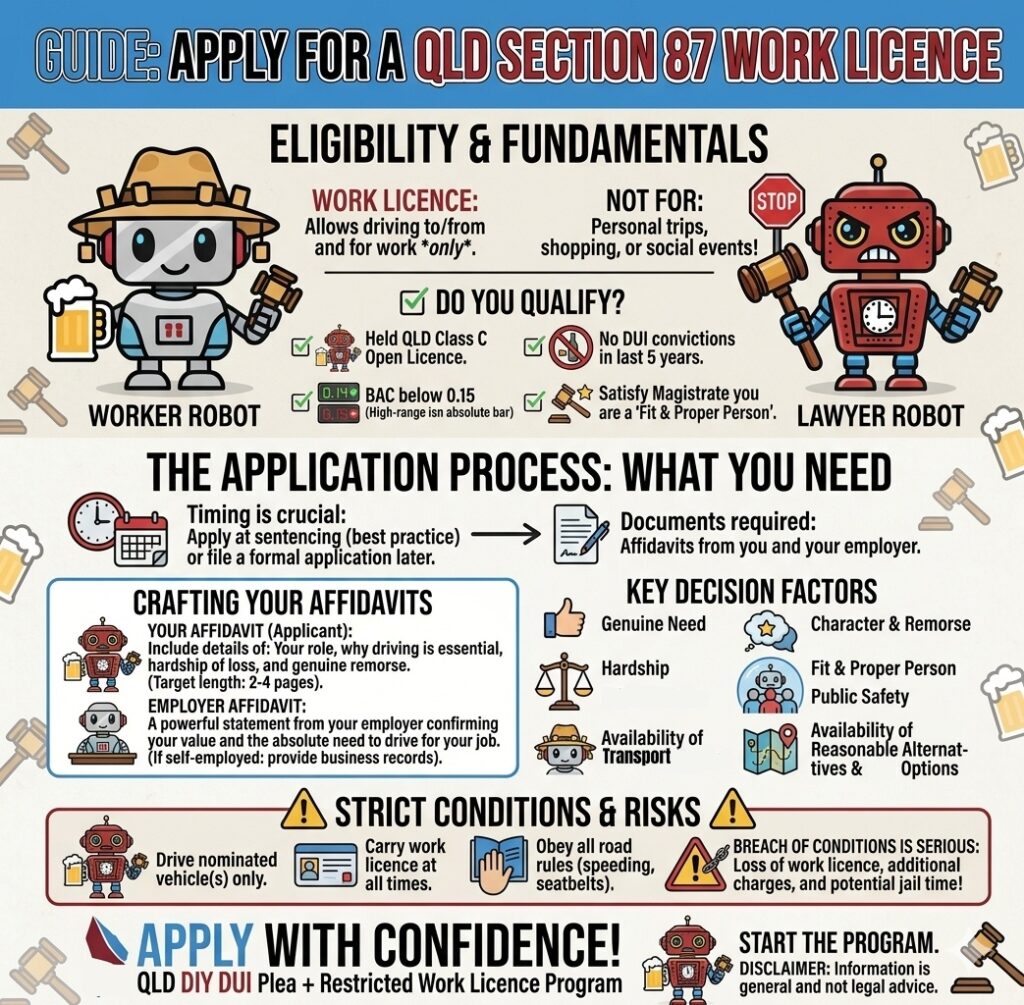
What it allows: You can drive to and from your place of work, and during the course of your work. This includes commuting and work-related driving.
What it doesn’t allow: You cannot use it for personal purposes—no social driving, no family outings, no driving to the shops. If you’re caught driving for non-work purposes, that’s a breach, and you can lose the licence.
Who issues it: Only a magistrate can issue a section 87 work licence. You apply to the Magistrates Court in the jurisdiction where you were convicted or where you live.
Conditions: The licence will have conditions attached. These typically include: you can only drive for work purposes; you can only drive the vehicle(s) specified on the licence; you must carry your work licence at all times when driving; and you must comply with all road rules (speeding, seatbelts, etc.). A breach of any condition can result in loss of the licence.
Who Can Apply — Basic Eligibility Requirements
You can only apply for a section 87 work licence if you meet several conditions. These are set out in the Transport Operations Act.
You must hold (or have held) a Queensland class C open licence. This is a standard car driving licence. If you held a different class of licence (e.g., you only have a truck licence, or a motorcycle licence), you can’t apply for a work licence under section 87. Your original licence must have been valid for general car driving.
You must be facing a disqualification that prevents you from driving. This means a magistrate has imposed (or is about to impose) a disqualification order on your licence. Section 87 only applies when you’re disqualified.
You must genuinely need to drive for work. This isn’t just “I have a job.” You must demonstrate that your job specifically requires you to drive, that the job is your primary means of earning a living, and that you can’t do the job without driving. If your work is genuinely work-from-home or you can use public transport or someone else can drive you, you won’t qualify.
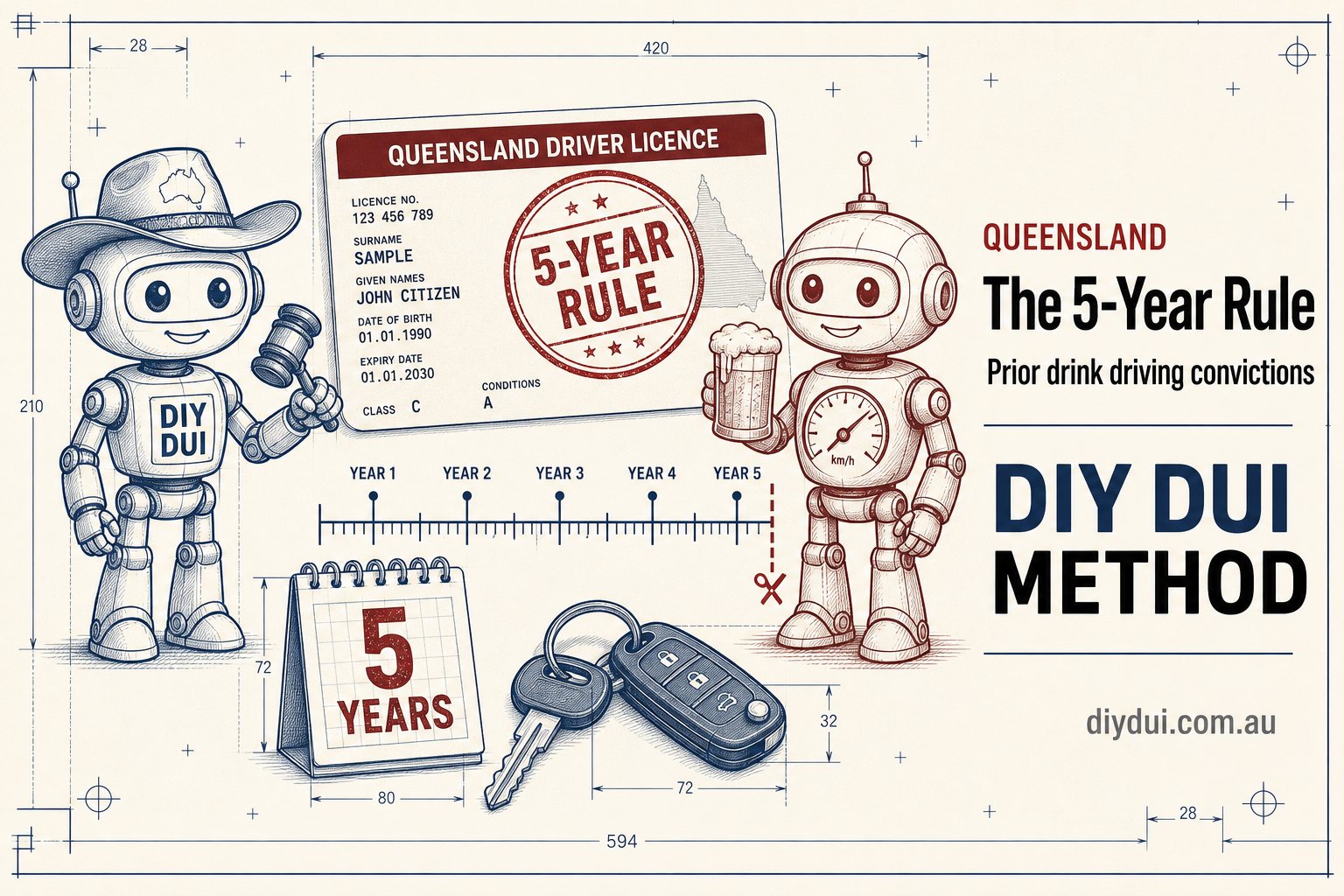
You must not be a repeat drink driver. This is critical: if you’ve been convicted of drink driving in the last 5 years before this application, you’re ineligible. “Last 5 years” means within 5 years before the application date. If you were convicted 6 years ago, you might be eligible. If it was 4 years ago, you’re not.
You must not be a high-range or very serious offender. If you were driving at a BAC of 0.15 or higher when charged, you’re ineligible. This is an absolute bar—the magistrate has no discretion.
Public transport must not be a viable alternative for your work. If a bus, train, or taxi could reasonably get you to and from work, your application might fail. However, if those options are genuinely impractical (they don’t run at the hours you need, they’re too expensive, your work requires tools or equipment you can’t carry on public transport), you can argue that they’re not viable.
You must satisfy the magistrate that you’re a “fit and proper person.” This is subjective. Generally, it means you’ve shown remorse for the drink driving offence, you’re not a repeat offender, and you’re unlikely to reoffend. Your behaviour since the charge matters.
When the Application Is Heard — Timing and the Court Process
You can make a section 87 application at two different times:
At the time of sentencing: After you’ve pleaded guilty and before the magistrate sentences you, you can say to the court: “I’d like to apply for a section 87 work licence.” The magistrate may hear your application at that same hearing, or they may adjourn and set a separate hearing date.
After sentencing: If you didn’t apply at the time of sentencing, you can apply later. You’ll file a formal application with the Magistrates Court registry, and the court will set a hearing date. This usually takes 2-4 weeks to be scheduled.
Best practice: If you know you want to apply, it’s better to apply at sentencing (or immediately after). Applying early shows the magistrate you’re serious about the matter. Plus, you’ll get a decision sooner. If you’ve already been sentenced without applying, you can still apply later, but you’ve lost the opportunity to present your case to the sentencing magistrate, who already knows your circumstances.
What happens at the hearing: The magistrate will hear your application. The police prosecutor may appear to oppose it or ask questions. You’ll have the opportunity to present evidence: affidavits (sworn statements), documents, and your own testimony. The magistrate will then decide whether to grant or refuse the application.
The Affidavit — What It Is and What Goes In It
An affidavit is a formal, sworn statement. It’s a document you or someone else writes, swear to be true in court, and present to the magistrate. The magistrate will rely heavily on affidavits in a work licence application.
Applicant Affidavit
You will prepare an affidavit about yourself. This affidavit should include:
Your personal details: Your name, date of birth, address, occupation, and employment history.
Your work situation: Describe your job in detail. What do you do? Who do you work for (employer name, or if self-employed, your business)? How long have you been in this job? Do you drive as part of your role? Be specific. “I’m a tradie and I drive to job sites” is better than “I drive for work.”
Why you need to drive: Explain why driving is essential for your job. What tasks require driving? Can someone else drive you? Can you use public transport? Why or why not? If public transport is unavailable at the hours you work, say so. If you need to carry tools or equipment that can’t fit on a bus, explain that. If your work requires you to visit multiple sites, explain the geography and why public transport doesn’t work.
The impact of disqualification: Explain what will happen to your job if you’re disqualified. Will you lose your job? Will your income drop? Will your employer let you use another driver? Be honest and specific. “I’ll lose my job” is a strong statement—only say it if it’s true. If you might lose your job or face significant hardship, that’s still worth saying.
Your circumstances: Describe your personal situation. Do you have dependents? Do you have financial obligations? Do you have health or caring responsibilities? These are relevant to the “genuine hardship” test.
The offence and your remorse: Acknowledge the drink driving offence. Express genuine remorse. Explain what you’ve learned. Have you done the Traffic Offenders Program? Have you engaged with counselling? Outline steps you’ve taken since the charge.
Your driving record: If you have a good driving history (clean record before the drink driving offence), mention that. If you’ve had other traffic offences, disclose them. Honesty is essential.
Why you’ll comply with conditions: Explain that you understand the licence is restricted and you will obey all conditions. You won’t drive for personal purposes. You understand the seriousness of a breach.
Your affidavit should be 2-4 pages, single-spaced. It should be clear, honest, and focused. Use plain language. The magistrate is reading dozens of affidavits—yours should stand out because it’s honest and shows genuine need.
Employer or Self-Employment Affidavit
A strong affidavit from your employer (or, if you’re self-employed, supporting evidence of self-employment) is crucial. This affidavit should come from your direct manager, owner, or supervisor—someone who knows your role and can speak to whether driving is essential.
What the employer affidavit should include:
Your employment details: Your name, job title, how long you’ve been employed, and your salary/hourly rate (optional, but helpful to show financial dependence).
Your role and driving requirements: What do you do? Describe the driving tasks. How often do you drive? What percentage of your job involves driving? Are there alternatives?
The impact of disqualification: Will you be able to continue in your role? Will you lose your job? If not, can someone else drive you to work (and if so, what’s the practical impact of that arrangement)? Be realistic here—if an alternative is genuinely available, the magistrate needs to know.
Your value to the business: A brief note about your reliability and importance to the business helps. This isn’t essential, but it supports your case.
The employer signs the affidavit under oath, swearing that the contents are true. This makes it powerful evidence.
If you’re self-employed: You can’t write an affidavit from yourself about your employment (conflict of interest). Instead, gather supporting evidence: business registration documents, recent tax returns, invoices, or a letter from a client confirming they rely on you for services that require driving. A bank statement showing income from your business also helps.
What the Magistrate Considers
The magistrate will weigh several things when deciding your application:
Genuine need to drive for work. Is your need real and substantial? Or could you manage with alternative transport or another driver? The magistrate has to believe you genuinely can’t do your job without a licence.
Hardship to you or your dependents. Would losing your licence cause genuine hardship? Financial hardship counts—if you’ll lose income and can’t pay rent or support dependents, that’s serious. The magistrate will consider your personal circumstances.
Your character and remorse. Do you seem genuinely sorry for the drink driving offence? Have you taken steps to address it (counselling, education programs)? Are you a repeat offender? Your credibility matters.
Fit and proper person test. Will you comply with the conditions of the licence? Are you likely to reoffend? The magistrate will assess whether they can trust you with a work licence.
Public safety. This isn’t about your personal need—it’s about whether issuing a work licence puts the public at risk. The magistrate will consider your offence (is it a high-range, mid-range, or low-range?) and whether you’re likely to reoffend.
Availability of reasonable alternatives. Are there alternatives? Could someone else drive you? Is public transport genuinely available? If reasonable alternatives exist, your application is weaker.
Common Reasons Applications Are Refused
Section 87 applications fail for several common reasons. Knowing these helps you avoid them:
You’re a repeat drink driver. If you’ve been convicted of drink driving within the last 5 years, you’re ineligible. This is an absolute bar—there’s no discretion.
Your BAC was high-range (0.15+). High-range offenders are considered too serious a risk. The law presumes they shouldn’t get a work licence.
You haven’t shown genuine need. Your affidavit says you need to drive, but the evidence doesn’t support it. For example, you say you need to drive for your job, but public transport runs directly to your workplace, or your employer says they can arrange another driver.
Public transport is available. If the magistrate is satisfied that a reasonable alternative exists (bus, train, taxi, another driver), your application is weakened. You need to argue convincingly why the alternative isn’t viable.
Weak or missing employer affidavit. If your employer’s affidavit is vague or doesn’t confirm that driving is essential, the magistrate won’t accept your claim. Get a strong, specific affidavit from someone with authority.
You haven’t shown remorse or addressed the offence. If your affidavit shows no remorse, or you haven’t taken any steps since the charge (no counselling, no education program), the magistrate may refuse you. The offence is too recent and you haven’t shown you’re serious about changing.
Financial hardship alone isn’t enough. Simply saying “I need the money” isn’t sufficient. You must show that loss of income will cause genuine hardship—you can’t pay rent, you have dependents, you have medical expenses, etc.
You’re trying to avoid the disqualification entirely. A work licence doesn’t eliminate your disqualification—it’s a limited exemption. If the magistrate senses you’re trying to get around the penalty, they’ll refuse.
What Conditions Apply to a Work Licence
If your application is successful, your work licence will come with strict conditions. You must understand and follow these:
You can only drive for work purposes. This means to and from your workplace, and during the course of your work. You cannot drive for social purposes, shopping, or personal errands.
You can only drive nominated vehicles. Your licence will specify which vehicle(s) you can drive (usually by registration number). You can’t drive a different car, even if it’s your family member’s car.
You must carry your work licence when driving. If you’re pulled over by police and don’t have your work licence with you, you’ve breached the condition. You could be arrested.
You must obey all road rules. Speed limits, seatbelt laws, red lights—all the usual rules apply. A traffic offence while on a work licence will be viewed very seriously and could result in loss of the licence.
Breach of conditions is serious. If you’re caught driving outside the terms of the licence (e.g., driving to the shops, or driving a different vehicle), you’ve breached the order. This can result in: loss of your work licence; additional criminal charges; and jail time in serious cases.
The licence is time-limited. Your work licence lasts for the duration of your disqualification. Once the disqualification period ends, the work licence ends automatically, and you can apply for full restoration of your licence (if eligible).
Step-by-Step Preparation Checklist
Here’s what to do to prepare a strong work licence application:
1. Check your eligibility. Before you do anything else, confirm: you held a class C open licence; you’re disqualified (or about to be); you’re not a repeat drink driver within 5 years; your BAC wasn’t 0.15 or higher. If any of these don’t apply to you, stop—you’re not eligible.
2. Gather employment documentation. Collect: your employment contract; recent payslips; letters from your employer confirming your role; business registration (if self-employed); recent tax returns; invoices or client letters (if self-employed).
3. Get an employer affidavit. Meet with your manager or employer. Explain what you need. Provide a template or ask them to write a clear affidavit about your role and the necessity of driving. Have them sign it in front of a witness or a Justice of the Peace. Get multiple copies.
4. Prepare your affidavit. Write a clear, honest affidavit about yourself, your job, why you need to drive, and the impact of disqualification. Use the structure outlined above. Have it checked by someone you trust. Get it sworn (signed in front of a JP or lawyer).
5. Gather supporting evidence. Collect character references, evidence of counselling or education programs you’ve completed, evidence of your remorse and efforts since the charge.
6. Decide on timing. If you haven’t been sentenced yet, plan to apply at sentencing. If you’ve already been sentenced, contact the Magistrates Court registry and ask how to file an application. You’ll need to provide all affidavits and supporting documents.
7. File the application (if not applying at sentencing). Submit all documents to the Magistrates Court registry in the jurisdiction where you were convicted or where you live. Ask for confirmation of receipt and a hearing date.
8. Prepare for the hearing. Practice your statement. Understand the conditions of the licence. Know your case inside out. Bring all original documents to the hearing.
9. Attend the hearing. Present your evidence clearly and honestly. Answer the magistrate’s questions directly. Don’t make excuses—focus on genuine need and remorse.
Frequently Asked Questions About Section 87 Work Licences in QLD
Q: How long does a work licence last? A: Your work licence lasts for the duration of your disqualification period. If you’re disqualified for 12 months, your work licence is valid for 12 months. Once the disqualification period ends, the work licence ends automatically.
Q: Can I drive anywhere with a work licence, or just to my workplace? A: You can only drive for work purposes. This means to and from your workplace, and during the course of your work. You cannot drive for personal purposes. If you need to take a detour for a personal errand, even a quick one, you’ve breached the condition.
Q: What if my employer says they’ll arrange another driver for me? A: If another driver is genuinely available, your need to drive is reduced. The magistrate may refuse your application, or they might grant it but with a narrower scope (e.g., only if the other driver isn’t available). If another driver is truly available, your case is weaker.
Q: What if I’m self-employed—do I have a better chance? A: Self-employed applicants aren’t treated differently in law, but they do face a different evidence challenge. You need to show that your business genuinely depends on you driving, and provide business documentation (tax returns, invoices, etc.). If you can meet that burden, your case is strong because there’s no alternative—you are the business.
Q: Can I change jobs while I have a work licence? A: You can, but you need to apply to vary the licence. The new job must still meet the “need to drive for work” requirement. Contact the Magistrates Court and explain the change. You’ll likely need a new affidavit from your new employer.
Q: What if the magistrate refuses my application—can I appeal? A: Yes, but appeals are difficult and expensive. You’d need to show an error of law, not just that the magistrate made a harsh decision. Seek legal advice if you’re considering an appeal.
Q: Can I have two work licences (one for two different jobs)? A: You can apply for a licence that covers work for multiple employers, but each vehicle must be specifically nominated. You can’t simply say “I can drive any car.” Be specific about which vehicles and which employers.
Q: What happens if I breach the conditions of my work licence? A: This is serious. Breaching conditions (e.g., driving for non-work purposes, driving an un-nominated vehicle) is a breach of a magistrate’s order. You can be charged, fined, and potentially jailed. You’ll definitely lose the work licence. Don’t breach the conditions.
Q: Can I apply for a work licence if I’m appealing my conviction? A: Generally no. A work licence application assumes you’ve pleaded guilty or been found guilty. If your conviction is under appeal, the situation is more complex. Seek legal advice before applying.
Safety Notice
If your matter is complex, you dispute police facts, or your situation falls outside what this program covers, you should consider speaking with an experienced traffic lawyer.
Apply for a work licence with confidence
Queensland section 87 restricted work licence.
The QLD DIY DUI Plea + Restricted Work Licence Program walks you through the entire application process, from affidavit preparation to the hearing.
Start the QLD DIY DUI Plea + Restricted Work Licence Program
Disclaimer: The information on this page is general in nature and does not constitute legal advice. Laws and penalties can change. Always verify current information with official sources. DIY DUI is an information and preparation resource only.