First Time Drink Driving Charge in NSW
The hours after a drink driving charge in New South Wales are disorienting. Police have processed you, handed you paperwork you may not fully understand, and sent you home. You may have had your licence suspended on the spot. A court date is on the horizon, and right now it feels enormous.
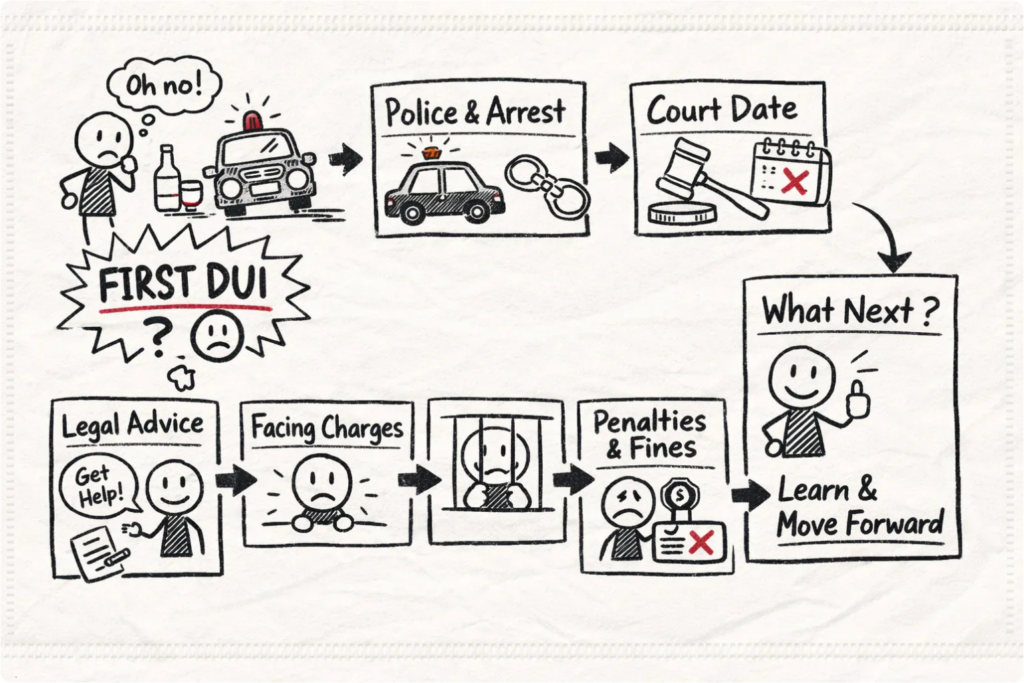
Here is the short answer: if this is your first offence and you intend to plead guilty, the NSW Local Court process is structured and manageable. You will attend a brief first mention, request an adjournment to prepare, and return for a sentencing hearing where the magistrate considers everything you put before them. What you do in the weeks between those two appearances makes a genuine difference to the outcome.
This guide walks you through every first time drink driving charge step in NSW — your charge paperwork, the court timeline, the penalties you’re actually facing, and the preparation steps that matter most.
Your Charge Paperwork — What It Means
The documents police hand you are not bureaucratic noise. Each one has a specific legal purpose, and understanding what you’ve received is the first step to taking control of your situation.
The Court Attendance Notice (CAN)
The Court Attendance Notice (CAN) is the document that sets the entire NSW Local Court process in motion. It tells you:
- The specific charge against you, including the offence category and your BAC reading
- Which NSW Local Court your matter will be heard in
- The date and time of your first court appearance
- Any bail conditions or licence conditions that apply to you
- Your personal details as recorded by police
Missing your court date is not an option. Failure to appear at NSW Local Court can result in the magistrate issuing a warrant for your arrest and potentially dealing with your matter in your absence.
Understanding Your BAC Range
NSW uses a tiered system of Prescribed Concentration of Alcohol (PCA) offences under the Road Transport Act 2013 (NSW). The range recorded on your CAN directly determines which penalty tier applies at sentencing:
- Special range: 0.02 to less than 0.05 (special category drivers, including learner, provisional and interlock licence holders, and bus, taxi and heavy vehicle drivers; learner and provisional drivers commit a novice range offence below 0.02)
- Low range: 0.05 to less than 0.08 (full licence holders)
- Mid range: 0.08–0.149
- High range: 0.15 and above
Your range does not shift at sentencing. It is fixed by your reading at the time of the offence. Knowing your range immediately tells you the realistic minimum and maximum penalties you are facing.
The Immediate Licence Suspension
For mid range and high range PCA offences in NSW, police can issue an on-the-spot licence suspension notice either at the scene or within 48 hours. This suspension takes effect immediately and runs until the court makes an order at sentencing. You cannot drive during this period. Driving while suspended carries separate serious charges that would significantly worsen your court situation.
The NSW Local Court Process — Step by Step
Your matter will be heard in the NSW Local Court. For a first time drink driving charge where you intend to plead guilty, the process generally moves through three stages.
Stage 1 — The First Mention
Your first court appearance is called the mention. It is brief — typically just a few minutes. The magistrate confirms your presence, the charge is read, and you are asked for your plea. This is not a full hearing. No evidence is tested, and no penalty is imposed at the mention.
If you intend to plead guilty but are not ready to be sentenced that day — which on a first-time charge you almost certainly are not — the mention is where you request an adjournment to prepare your materials.
Presentation matters from day one. Dress neatly, arrive early, and address the magistrate as “Your Honour.” How you carry yourself at the mention sets an early impression that carries into your sentencing appearance.
Stage 2 — The Adjournment Period
An adjournment is a postponement of the sentencing hearing. NSW Local Courts routinely grant adjournments to first-time offenders with no prior record, particularly where the defendant needs time to complete a Traffic Offenders Program or gather supporting documentation. The adjournment typically adds four to eight weeks to your timeline.
That time is not dead time. It is the window where you do the preparation that directly influences your sentencing outcome. Failing to use it well is one of the most common and costly mistakes first-time defendants make.
Stage 3 — Sentencing Day
This is the appearance that counts. The police prosecutor will read the facts sheet and your traffic history to the court. You then have the opportunity to make your submissions — explaining your personal circumstances, your remorse, and the concrete steps you have taken since being charged.
The magistrate considers everything before them — the charge, your traffic history, your submissions, and your supporting documents — before imposing a penalty. Every document you prepare in the weeks before this day feeds directly into what that penalty looks like.
NSW Penalties for a First Drink Driving Offence
Courts have discretion within statutory ranges. Knowing those ranges before your sentencing day means you can calibrate your expectations and understand what strong preparation can realistically achieve. The penalty ranges below are for first offenders under the Road Transport Act 2013 (NSW). Always verify current figures with Transport for NSW or NSW Legislation, as penalty amounts can be updated.
Low Range PCA (0.05 to less than 0.08) — First Offence
- Maximum fine: $2,200
- Automatic disqualification: 6 months (if court makes no specific order)
- Minimum disqualification (court order): 3 months
- Maximum disqualification: 6 months
- Imprisonment: Not applicable for first offence
- Interlock: Not required for first low range offence
A Section 10 dismissal — where the magistrate finds you guilty but records no conviction — is a realistic outcome for well-prepared first-time low range offenders who demonstrate genuine remorse and present strong supporting material. It is not guaranteed, and it cannot be predicted. But it is the reason preparation matters.
Mid Range PCA (0.08–0.149) — First Offence
- Maximum fine: $2,200
- Automatic disqualification: 12 months
- Minimum disqualification (court order): 6 months
- Maximum disqualification: Unlimited
- Maximum imprisonment: 9 months
- Interlock: Mandatory interlock period applies after disqualification
The mandatory interlock requirement means that after serving your disqualification period, you must have an approved alcohol interlock device fitted to any vehicle you drive. For a first mid range offence, this interlock period runs for a minimum of 12 months. You cannot drive without the device during that period.
High Range PCA (0.15 and Above) — First Offence
- Maximum fine: $3,300
- Automatic disqualification: 3 years
- Minimum disqualification: 6 months (interlock period follows)
- Maximum imprisonment: 18 months
- Interlock: Mandatory — minimum 24 months after initial disqualification
These are the legal maximums. First-time offenders with no prior history and strong preparation consistently receive sentences toward the lower end of these ranges. That is why preparation is not optional — it is the mechanism through which you access the lower end of the range.
What Magistrates Focus On at Sentencing
Understanding what a NSW magistrate is weighing up when they sentence you helps you build your preparation around the things that actually count.
Magistrates consider the objective seriousness of the offence — meaning your BAC level, the circumstances of the driving, and whether anyone else was put at risk. They also weigh subjective factors, which is everything personal to you: your prior record, your employment, your family circumstances, your remorse, and the steps you have taken since the charge. In a first-time guilty plea, the subjective factors are where you have the most influence.
Key factors that consistently work in a defendant’s favour in NSW Local Court include:
- Genuine, specific remorse — not a vague apology
- Completion of an approved Traffic Offenders Program before sentencing
- No prior criminal or traffic history
- Strong, credible character references
- Early guilty plea (the court must take it into account and may reduce your penalty)
- Licence dependency — where loss of licence threatens employment or carer responsibilities
The Preparation Steps That Make a Real Difference
Between your mention and your sentencing day, you have a window of time that is genuinely useful. The steps below are what NSW magistrates actually respond to.
Complete a Traffic Offenders Program
Enrolling in and completing an approved Traffic Offenders Program (TOP) before your sentencing date is one of the most effective steps a first-time defendant can take. NSW courts treat completion as concrete evidence that you have acknowledged your behaviour and taken active steps toward rehabilitation.
The completion certificate you bring to sentencing day can directly influence whether the magistrate applies minimum disqualification periods, reduces your fine, or considers alternatives such as a Section 10. Programs typically run six to eight weeks — enrol immediately after your first mention to ensure you have time to finish.
Gather Strong Character References
Character references should come from people who know you well — personally, professionally, or through community involvement — and who can speak honestly to your reliability and low risk of reoffending. Two to three strong, specific references carry more weight than five generic ones.
Each reference should be addressed to the magistrate, confirm the referee’s relationship to you, and speak to specific qualities that are relevant to sentencing — your responsibility, your community ties, your low risk of reoffending.
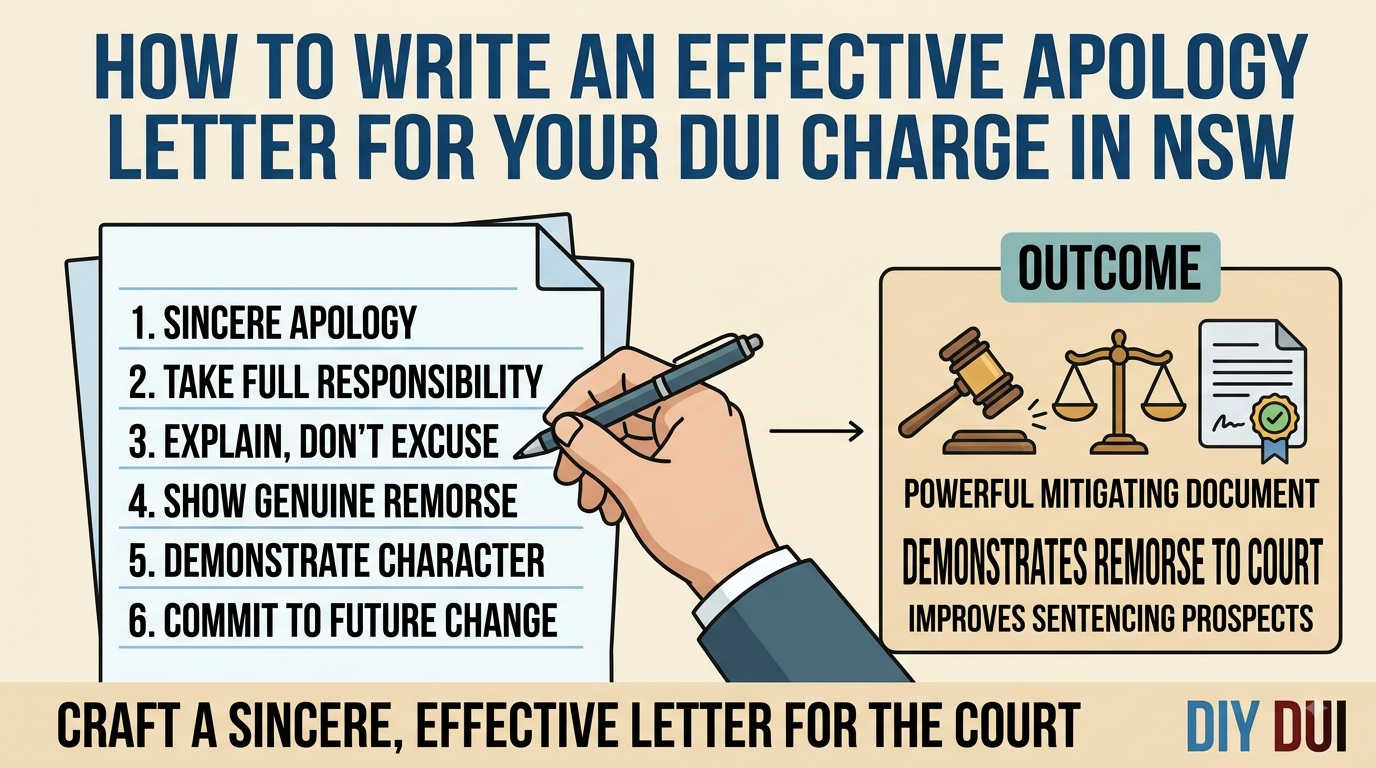
Write a Genuine Apology Letter
Your apology letter is your direct written communication to the court. It needs to be specific about what you understand you did wrong, demonstrate genuine insight rather than excuses, and be written in your own voice. Magistrates read many of these letters and can quickly distinguish a sincere, personal letter from a formulaic one. Focus on accountability, not deflection.
Prepare Your Oral Submissions
Your oral submissions are the opportunity to speak directly to the magistrate about your circumstances: your employment situation, your traffic history, your family responsibilities, and the concrete steps you have taken since the charge. Keep your submissions structured, respectful, and focused on the factors that matter to the court.
What to Bring on Sentencing Day
- Your Traffic Offenders Program completion certificate
- Your written character references (original copies)
- Your apology letter addressed to the magistrate
- Proof of employment or evidence of licence dependency if relevant
- Any medical or mental health documentation that provides relevant context
- Your notes for your oral submissions
Self-Representation in NSW Local Court — Is It Realistic?
For many first-time drink driving matters in NSW with no aggravating factors — no accident, no children in the vehicle, no refusal to provide a breath sample — self-representation on a guilty plea is a genuine option. NSW Local Court magistrates regularly see unrepresented defendants, and they respond positively to those who arrive prepared, speak respectfully, and present well-organised submissions.
Legal representation for a straightforward drink driving matter in NSW typically costs between $2,000 and $5,000. For many first-time offenders, that cost is difficult to justify on a matter that is not complex and where a guilty plea is the intended course. The question to ask yourself is not whether a solicitor could help — they can — but whether the cost is justified given the nature of your specific matter.
Key Takeaway: A first time drink driving charge in NSW is serious — but it is manageable. The court process is structured and predictable. The preparation you do between your mention and your sentencing day is the biggest variable within your control. Use that time well.
Frequently Asked Questions — First Time Drink Driving Charge NSW
Will I get a criminal record for a first drink driving offence in NSW?
Not necessarily. A drink driving conviction in NSW is a criminal record entry. However, for first-time low range offenders who present strong mitigation, a magistrate may deal with the matter under Section 10 of the Crimes (Sentencing Procedure) Act 1999 (NSW), which allows a finding of guilt with no conviction recorded. This outcome is not available on demand — it depends on the full picture you present to the court.
How long will my licence be suspended before I go to court?
If police issued you a suspension notice at the time of the charge, your licence is suspended from the date of that notice until the court makes an order at sentencing. The length of time depends on how quickly your matter moves through court — which is typically eight to twelve weeks for most first-time matters in NSW.
Do I have to complete a Traffic Offenders Program?
There is no legal requirement to complete a Traffic Offenders Program before your sentencing hearing. However, NSW courts consistently view completion as a significant positive factor. For first-time offenders aiming for a minimum penalty or a Section 10, it is one of the most impactful steps you can take. The cost is generally modest — typically between $150 and $350 for a community-run program.
What is the interlock scheme and does it apply to me?
The NSW alcohol interlock scheme requires convicted drink drivers to have an approved interlock device fitted to their vehicle before they can drive again after their disqualification period. For first offences, the scheme is mandatory for mid range and high range PCA convictions. Low range first offenders are not subject to the mandatory interlock scheme. Interlock information is available from Transport for NSW.
Can I write a letter instead of attending court in person?
Attending NSW Local Court in person is strongly advisable. A written plea is technically available in some circumstances, but magistrates consistently view personal attendance as a sign of respect for the process and seriousness about the outcome. Failing to attend in person, when you are capable of doing so, can work against you at sentencing.
Will I go to jail for a first drink driving offence in NSW?
For a first low range PCA offence, imprisonment is not a sentencing option. For a first mid range offence, imprisonment of up to 9 months is a statutory maximum, but full-time custodial sentences for first-time offenders with no prior record are uncommon on straightforward matters. High range offences carry greater risk, particularly where aggravating factors are present. A magistrate has wide discretion, which is why preparation and mitigation matter.
How early should I arrive at the NSW Local Court?
Arrive at least 30 minutes before your listed time. This gives you time to find the correct courtroom, speak to the police prosecutor if needed, and settle yourself before your matter is called. Rushed, late arrivals are noticed. Early, composed arrivals make a positive impression from the outset.
Important: If your matter is complex, you dispute police facts, or your situation falls outside what this program covers, you should consider speaking with an experienced traffic lawyer.
Ready to Walk Into NSW Court Prepared?
If you want step-by-step guidance to walk into NSW Local Court prepared and confident, the NSW DIY DUI Plea Program covers everything in this article — and everything you need for sentencing day.
If you want step-by-step guidance to walk into NSW Local Court prepared and confident, the NSW DIY DUI Plea Program covers everything in this article — and everything you need for sentencing day. It’s built specifically for first-time guilty plea defendants who want to give themselves the best realistic chance without the cost of a solicitor.
Legal Disclaimer: The information on this page is general in nature and does not constitute legal advice. Laws and penalties can change. Always verify current information with official sources. DIY DUI is an information and preparation resource only.