NSW Drink Driving Penalties & Laws Explained
If you’ve been charged with drink driving in NSW, understanding exactly what offence you’re facing — and what the penalties are — is the first step to preparing properly for court.
NSW drink driving penalties depend on three things: your blood alcohol concentration (BAC), whether it’s your first or a repeat offence, and the specific circumstances of the offence. This guide covers all three categories — Low Range, Mid Range, and High Range — along with licence disqualification, the mandatory interlock scheme, and what the magistrate will look at when deciding your sentence.
You can’t change your BAC reading. But you can prepare. And preparation genuinely makes a difference to how your matter is handled in NSW Local Court.
NSW Drink Driving Offences — The BAC Categories
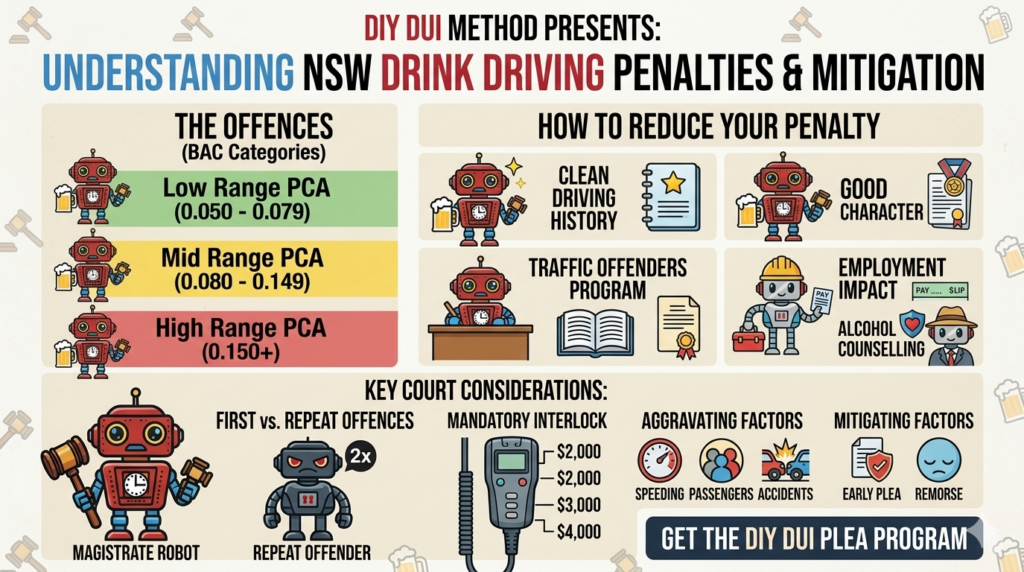
Under the Road Transport Act 2013 (NSW), drink driving is divided into three categories based on your blood or breath alcohol concentration. Each category carries different penalties. Knowing which category applies to you is essential before you appear in court.
Low Range PCA (0.05 to less than 0.08)
A Low Range Prescribed Concentration of Alcohol (PCA) applies when your BAC was 0.05 or more but less than 0.08. This is the most common drink driving offence in NSW.
For a first low-range offence, the maximum penalty is a fine of $2,200. Licence disqualification is mandatory: an automatic 6 months, which the court can reduce to a minimum of 3 months. No mandatory interlock order applies to a first low-range offence. There is no term of imprisonment for a low-range offence.
Novice and special category drivers — lower limits apply: Learner and provisional drivers must have a zero BAC — any alcohol detected can be an offence. Professional or special category drivers (taxi, bus, heavy vehicle) must stay under 0.02. If you held one of these licences, your penalties may be more severe even at low-range BAC levels.
Mid Range PCA (0.080–0.149)
A Mid Range PCA applies when your BAC was between 0.080 and 0.149. This is considered moderate-range drink driving under NSW law.
For a first mid-range offence, the maximum penalty is a fine of $2,200 and up to 9 months imprisonment. Licence disqualification is an automatic 12 months (minimum 6 months). Unless the court makes an interlock exemption order, it must make a mandatory interlock order: a disqualification of 3 to 6 months, then a 12-month interlock period.
Imprisonment is not automatic. The magistrate will weigh your personal circumstances, your driving history, and whether aggravating factors exist — such as speeding, carrying passengers, or causing an accident.
High Range PCA (0.150 and above)
A High Range PCA applies when your BAC was 0.150 or higher. This is the most serious drink driving offence in NSW.
For a first high-range offence, the maximum penalty is a fine of $3,300 and up to 18 months imprisonment. Licence disqualification is an automatic 3 years (minimum 12 months). Unless the court makes an interlock exemption order, it must make a mandatory interlock order: a disqualification of 6 to 9 months, then a 24-month interlock period.
For high-range offences, a custodial sentence is a real possibility — particularly for repeat offenders or where aggravating circumstances exist.
Mandatory Interlock: All first-time high-range PCA offenders are subject to a mandatory alcohol interlock order unless the court makes an interlock exemption order, which is available only in very limited circumstances. The interlock device is fitted to your vehicle and requires a breath sample before the car will start. Total costs typically exceed $2,000 over 12–24 months.
Penalty Ranges — First Offence vs Repeat Offence
NSW law treats repeat offenders significantly more harshly than first-time offenders. A “repeat” offence is a second or subsequent offence within 5 years of a previous conviction for a major offence (or a penalty notice for an alcohol or other drug related driving offence).
Here’s how penalties escalate for repeat offenders:
- Repeat Low Range: Maximum fine of $3,300. Automatic disqualification of 12 months (minimum 6 months). A mandatory interlock order applies only where the first offence was any other alcohol-related major offence.
- Repeat Mid Range: Maximum fine of $3,300 and up to 12 months imprisonment. Automatic disqualification of 3 years (minimum 12 months), with a mandatory interlock period of 24 months.
- Repeat High Range: Maximum fine of $5,500 and up to 2 years imprisonment. Automatic disqualification of 5 years (minimum 2 years), with a mandatory interlock period of 48 months.
The court views repeat offending very seriously. If you’ve been convicted of a drink driving offence before — even in a different state — you need to be prepared for that history to affect your sentence.
Licence Disqualification in NSW
If you are convicted of a drink driving offence in NSW, licence disqualification is automatic. The question is usually only how long the disqualification period will be.
The magistrate must impose a minimum period based on your BAC category and offence history, but has discretion to impose a longer disqualification. Your personal circumstances — including employment and family responsibilities — are relevant when the magistrate is setting this period.
Disqualification generally takes effect from the date of sentence. Your disqualification begins on the day you are convicted unless the magistrate orders that it begin on a later day.
Driving while disqualified is a separate, serious offence. If you’re caught driving during your disqualification period, you face additional penalties including fines, a further disqualification, and potentially imprisonment. There is no work exemption or conditional licence in NSW equivalent to the QLD work licence scheme.
A court disqualification cancels your licence, and you must apply for a new licence when the disqualification ends.
The NSW Mandatory Interlock Scheme
NSW has operated a mandatory interlock scheme since February 2015. An alcohol interlock is a breath-testing device fitted to your vehicle. Before the car will start, you must provide a breath sample. If alcohol is detected above a set threshold, the car will not start.
Who Must Have an Interlock?
- All high-range and mid-range PCA offenders (BAC 0.08 or more), including first offenders
- Drivers convicted of DUI (alcohol), combined alcohol and drug driving, or refusing breath analysis
- Repeat novice, special or low-range offenders — only where the first offence was any other alcohol-related major offence
Interlock Periods and Costs
Interlock orders typically run for 12 to 48 months depending on your offence. For example, a first-time high-range offender may receive a 6 to 9 month licence disqualification followed by a 24-month interlock period. After the disqualification ends, you can drive again — but only in a vehicle fitted with the device.
You pay for all interlock costs:
- Installation: approximately $400–$600
- Servicing (required every 2–4 weeks): approximately $80–$150 per service
- Removal: approximately $100–$200
- Total cost for a 24-month interlock period: typically $2,000–$3,000 or more
Anyone else who drives your vehicle during the interlock period must also provide a breath sample before the car will start. Breaching the interlock order — for example, being recorded attempting to drive with alcohol detected — can result in further penalties, including losing your licence again or imprisonment.
For current information on the NSW interlock scheme, visit Service NSW — Alcohol Interlock Program.
What NSW Courts Consider on Sentence
Once you’ve pleaded guilty, the magistrate moves to sentencing. They’ll weigh up a range of factors before deciding what penalty to impose. Understanding these factors helps you prepare the right material to present at court.
- Your BAC level: A reading of 0.160 is treated more seriously than 0.051 — even within the same category.
- Your driving history: First offence vs repeat offence makes a major difference. Any prior convictions may also be considered.
- Your age and experience: A young driver may attract closer scrutiny. A mature driver with decades of clean history may receive a lighter sentence.
- Employment and personal circumstances: If your licence is essential for work, this is relevant — though it cannot eliminate the mandatory disqualification.
- Family responsibilities and health: Caring responsibilities, medical conditions, and financial hardship are all relevant to sentencing.
- Aggravating circumstances: Causing an accident, carrying passengers, speeding, or being charged in a school zone will push the sentence higher.
- Steps taken after the offence: Completing a driver education program, seeking counselling, or voluntarily installing an interlock all demonstrate genuine remorse.
Aggravating and Mitigating Factors in NSW
The magistrate will balance the factors for and against you when deciding your sentence. You cannot change the aggravating factors — but you can present strong mitigation.
Aggravating Factors (increase sentence severity)
- Causing an accident or injuring someone
- Driving in a school zone, residential area, or heavy traffic
- Speeding or other traffic violations at the time of the offence
- Carrying passengers, especially children
- Late-night or early-morning driving
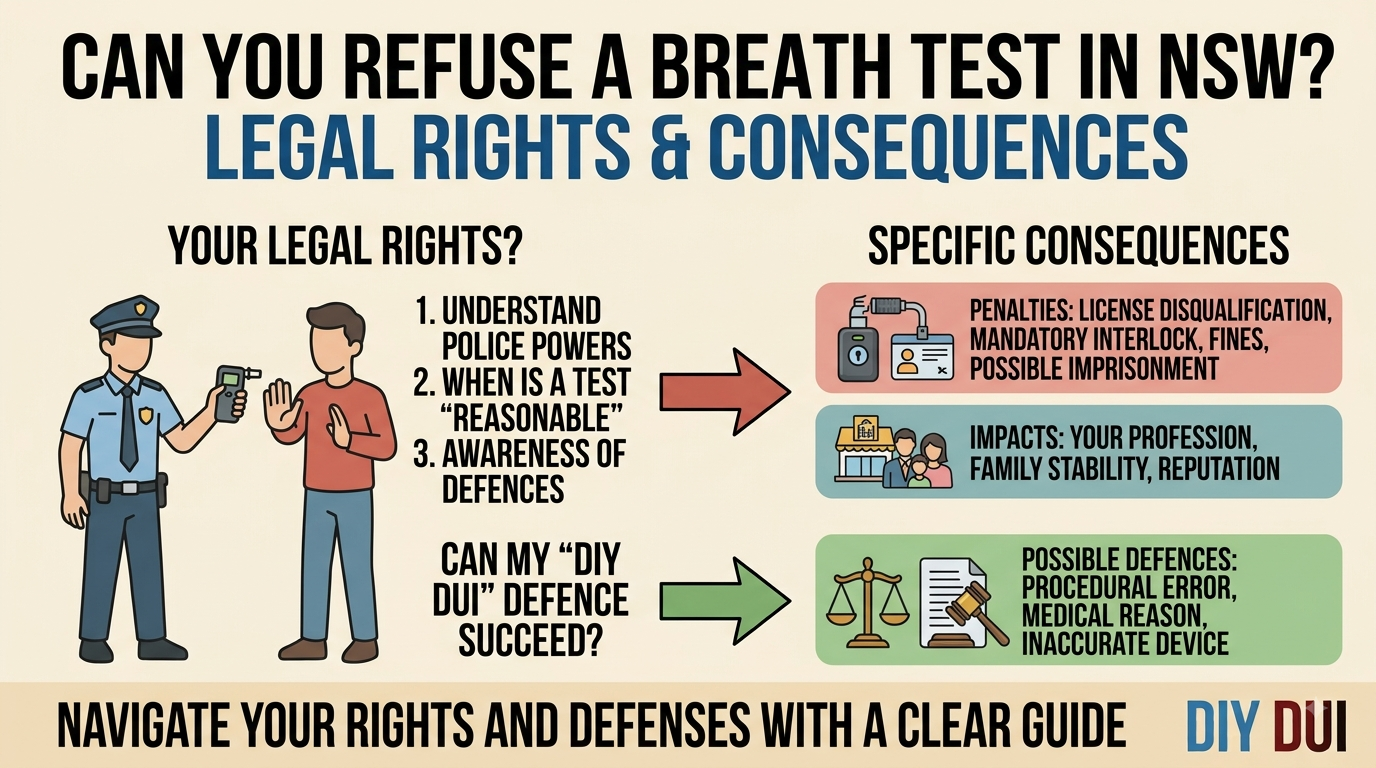
- Refusing a breath test
- Previous traffic infringements or convictions
- BAC reading at the high end of the category range
Mitigating Factors (can reduce sentence severity)
- First offence with an excellent prior driving record
- Early guilty plea — shows remorse and saves court time
- Completion of a driver education or Traffic Offenders Program
- Counselling or treatment for alcohol use
- Strong character references from employers, community leaders, or others
- Licence is essential for work or family care responsibilities
- Youth and inexperience (in appropriate circumstances)
- Concrete steps taken since the charge to address the issue
Can You Avoid a Conviction? Section 10 in NSW
Under section 10 of the Crimes (Sentencing Procedure) Act 1999 (NSW), a magistrate has the power to find you guilty but decline to record a conviction — or to dismiss the charge entirely. Without recording a conviction, the magistrate can dismiss the charge (s 10(1)(a)) or discharge you under a conditional release order (s 10(1)(b)).
In practice, section 10 outcomes in drink driving cases are rare. The offence is considered too serious for dismissal in most circumstances. However, a magistrate may consider it, weighing the section 10(3) factors such as your character and antecedents, the trivial nature of the offence (for example, a very low BAC on a first offence) and the extenuating circumstances.
Important: A section 10 dismissal means no conviction is recorded, so no licence disqualification or interlock order is imposed. Do not approach court expecting a section 10. Focus instead on preparing strong mitigation to achieve the best possible sentence.
How to Prepare for Your NSW Drink Driving Sentence
You cannot change your BAC reading or undo the offence. But the preparation you do before court genuinely influences the outcome. Here’s what actually makes a difference.
Complete a driver education program. The Traffic Offenders Program and similar courses show the magistrate you’ve taken the matter seriously and engaged with road safety. Bring your certificate on the day.
Seek counselling or treatment if alcohol is an issue. Engaging with a GP or counsellor — and getting a letter confirming this — demonstrates active, genuine remorse. This is one of the most effective mitigation steps available.
Gather character references. One to three well-written references from your employer, community members, or people who know you well can persuade a magistrate that the offence was out of character. Quality over quantity.
Document your employment situation. If your licence is essential for your livelihood, get a letter from your employer confirming this — ideally specifying that driving is required. Attach payslips or a copy of your employment contract if relevant.
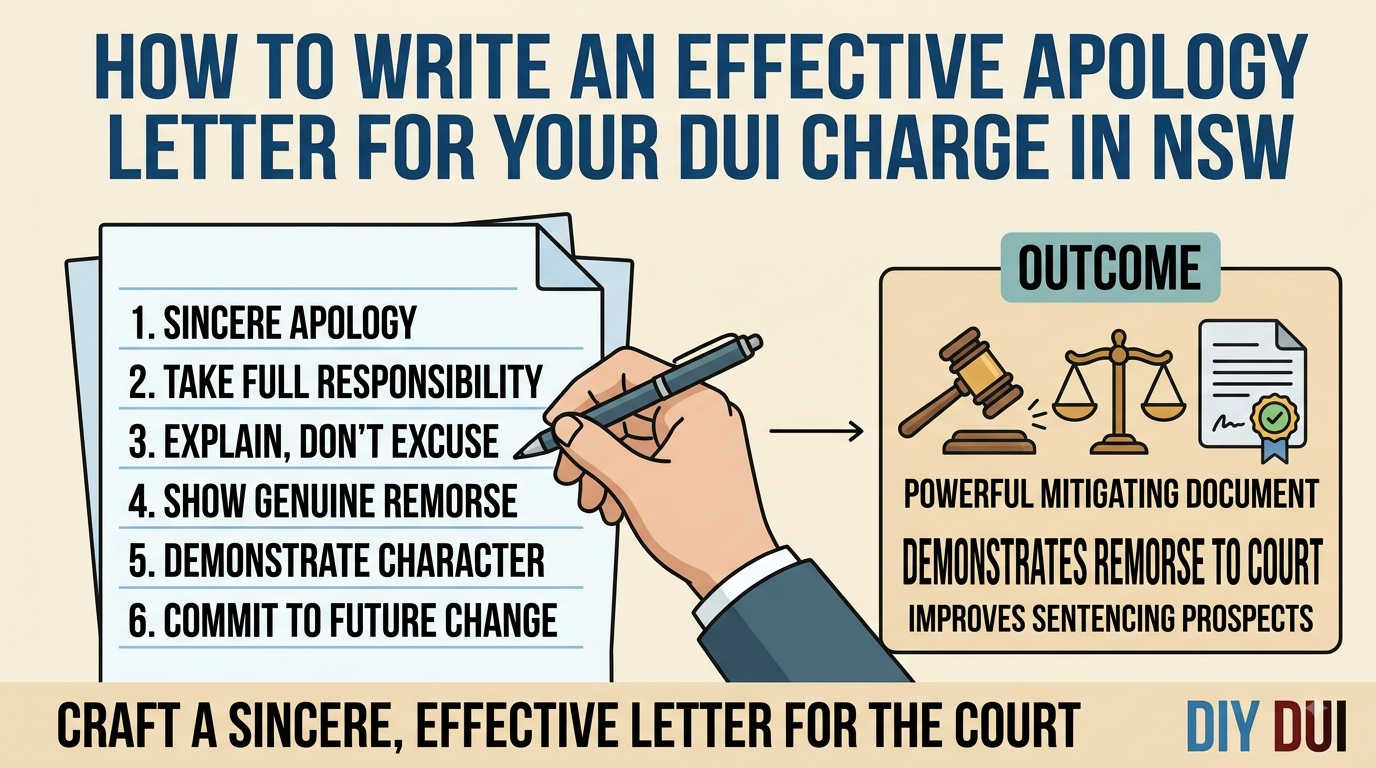
Prepare a brief personal statement for court. Know what you want to say to the magistrate — around five to ten minutes. Cover the context, show genuine remorse, and explain what you’ve done since the charge. Practice it beforehand so you’re calm and clear when it matters.
For the current penalty provisions, refer to the Road Transport Act 2013 (NSW) on the NSW legislation website.
Key Takeaway: NSW drink driving penalties are structured by BAC category, and repeat offenders face significantly harsher sentences. Licence disqualification is mandatory across all categories — but the strength of your preparation and mitigation can make a real difference to the overall sentence imposed.
Frequently Asked Questions About NSW Drink Driving Penalties
Q: Can I drive to work during my licence disqualification in NSW?
No. Disqualification in NSW means you cannot legally drive at all during that period — there is no work exemption or conditional licence. If caught driving while disqualified, you will face a separate, serious offence including additional fines, further disqualification, and potentially imprisonment.
Q: Will a NSW drink driving conviction give me a criminal record?
In most cases, yes. A guilty finding in NSW Local Court for a drink driving offence results in a criminal conviction. In some cases a magistrate may make a section 10 order and not record a conviction — but this is uncommon for drink driving and should not be expected. The conviction stays on your record, but under the Criminal Records Act 1991 (NSW) it generally becomes spent after 10 consecutive crime-free years (unless a prison sentence of more than 6 months was imposed), and a spent conviction usually does not have to be disclosed.
Q: Will I go to jail for drink driving in NSW?
Imprisonment is possible for mid-range and high-range PCA offences in NSW, and the risk increases significantly for repeat offenders. Imprisonment is not available at all for a low-range offence, and for most first-time mid-range offenders imprisonment is unlikely if you present strong mitigation and a clean driving history. The magistrate has discretion, and preparation genuinely matters.
Q: What if I was over the limit but didn’t drive dangerously?
Drink driving in NSW is a strict liability offence — once your BAC is established, the charge is made out regardless of how carefully you drove. The quality of your driving is not a defence. However, the absence of dangerous driving may be considered as a mitigating factor when the magistrate is deciding the penalty.
Q: Will a drink driving conviction affect my job?
It may. If your job requires you to drive — truck, taxi, delivery, or any other driving role — a conviction and disqualification will almost certainly affect your employment. Even in non-driving roles, some employers may take a conviction seriously. Check your employment contract for disclosure obligations, and consider speaking with your employer proactively.
Q: Will my insurance be affected after a drink driving conviction in NSW?
Yes. Most insurance policies exclude cover if you were driving under the influence at the time of an accident. After a conviction, your premiums will typically increase and some insurers may decline to cover you. You have an obligation to disclose the conviction when your policy renews. Check your policy terms carefully.
Q: Is there a work licence or hardship licence in NSW like in Queensland?
NSW does not have a direct equivalent to Queensland’s Section 87 Work Licence. A court disqualification cancels your licence, and there is no hardship or restricted licence to apply for.
Q: If I refused the breath test, what happens?
Refusing a breath test is itself a separate offence under NSW law and is treated very seriously by the court. Without a confirmed BAC, the prosecution must prove the offence differently — but this is complex legal territory. If you refused a test and are unsure about your position, this is one of the situations where speaking with a traffic lawyer is strongly recommended.
Q: Can the magistrate change my disqualification period after sentencing?
Not to shorten it because your circumstances have changed. However, once you have been offence-free for the required period (4 years where the disqualification arose from a major offence such as drink driving), you can apply to the Local Court to have the disqualification removed under section 221B of the Road Transport Act 2013. The court considers public safety, your driving record and the impact of the disqualification on you, and removal is not automatic.
Q: Can I appeal my sentence in NSW?
Appeals from the NSW Local Court to the District Court are possible within a set timeframe. To succeed, you would generally need to show that the sentence was manifestly excessive or that there was a legal error. Appeals are complex and expensive, and most people in drink driving matters do not pursue them. If you’re considering an appeal, you should speak with a lawyer.
Important: If your matter is complex, you dispute police facts, or your situation falls outside what this program covers, you should consider speaking with an experienced traffic lawyer.
Understand Your Penalties. Walk Into Court Prepared.
Knowing the law is only the first step.
Knowing the law is only the first step. The NSW DIY DUI Plea Program guides you through everything you need to prepare a strong plea — from gathering the right documents to knowing what to say to the magistrate.
Legal Disclaimer: The information on this page is general in nature and does not constitute legal advice. Laws and penalties can change. Always verify current information with official sources. DIY DUI is an information and preparation resource only.